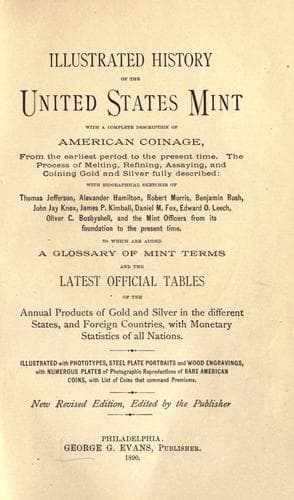
Illustrated history of the United States mint: with a complete description of American coinage, from the earliest period to the present time
History
Illustrated history of the United States mint: with a complete description of American coinage, from the earliest period to the present time
Coinage -- United States; Mints -- United States
It is worth while to add that a visitor at the mint saw a
similar piece in Jerusalem, and tried to obtain one, but on
account of its rarity did not succeed.
W. E. D.
DONATIONS OF OLD COINS.
_Extract from the American Journal of Numismatics, April, 1884._
Under the head of donations, we have from Quartermaster General
Meigs, a half-dollar and pistareen of Carolus and Johana of
Spain. These pieces were presented to General Meigs at Corpus
Christi, Texas, in 1870. The special interest attached to them,
is their having been found on the beach of Padre Island, off
the southerly coast of Texas. The supposition is that they were
washed up from a sunken treasure ship wrecked on the coast,
while carrying funds to the Army of Cortez, who entered the
City of Mexico in 1519. Their good condition may warrant our
accepting this briny romance _Cum grano salis_. Antiquarian
stories must expect to stand the test of the chemist, as
well as of the historian. This reminds me, however, of some
specimens of the Mint Cabinet, from the wreck of the San Pedro,
some account of which may not be uninteresting here.[17] “Early
in 1815, a naval armament was fitted out in Spain, by Ferdinand
VII., for the purpose of reducing the Rebellious Colonies in
South America. The military force of this expedition amounted
to ten thousand men, of whom two thousand were on board the
flag ship “San Pedro.” The vessel was also freighted to a large
amount with gunpowder, cannon balls and specie.”
The account then goes on to state that the fleet touched at the
Island of Marguerita near the coast of Venezuela. After leaving
the island, the vessel took fire, burnt four hours until the
magazine caught and exploded, and the wreck went down with four
hundred men. The right of working the wreck, was granted about
thirty years after, to a Baltimore Company, known as the “San
Pedro Company.” Divers were set to work, and the wreck found in
sixty feet of water on a hard bed of coral. Over this there was
a deposit of mud, and again over this a layer of coral, which
had to be pierced to arrive at the treasure.
Public-domain text, read in full here on John Shaqi.
Reviews
Reviews
No reviews yet
Be the first to share your thoughts on this work.
Elsewhere in the archive
Join the Discussion
Join the discussion
Sign in to leave a comment or review.
Sign InorCreate an account