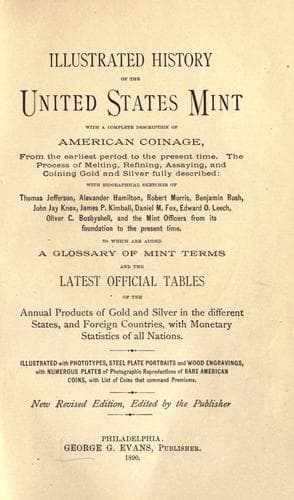
Illustrated history of the United States mint: with a complete description of American coinage, from the earliest period to the present time
History
Illustrated history of the United States mint: with a complete description of American coinage, from the earliest period to the present time
Coinage -- United States; Mints -- United States
The widow’s mite in our showcase of specialties, always
attracting much attention, is precisely what the Scriptures
speak of—a _lepton_, the smallest of Greek and Syriac coins.
The name comes from _leptos_, very small. The word “mite” is
English, and was formerly a weight representing the twentieth
part of a grain, but has long fallen into disuse. It was
employed in the translation of the New Testament to represent
the word _lepton_, simply because it was so very small.
It is pretty certain that there was no Jewish or Hebrew coin
so small as the _lepton_; that people depended very much upon
outside coins for their circulation. Even their money terms
had changed to those of the Syrian-Greek Empire and of Rome,
as we see from all the instances in the New Testament. What
few copper or bronze pieces they had, struck by local princes
for a limited time, and now very rare, were large enough to
bear a show of devices and inscriptions, for which the _lepton_
was too minute. The one in our cabinet has a diameter of only
three-tenths of an inch, and weighs but ten grains. On one side
nothing is discernible, on the other a mint monogram, such as
were common in that era, occupies the space. It is much like
the letter x, with a line crossing it near the top. Whether it
is Samaritan, or Syriac, or Greek, we cannot be sure; nor is
it of any consequence. It is enough to show that it is a coin,
and belongs to the age shortly before and after the advent of
Christ, and its size proves it to be a _lepton_.
It is an interesting and confirmatory fact, that this piece
was found among the rubbish of the Temple grounds, by Dr.
Barclay, long resident in Jerusalem, and author of “The City of
the Great King.” By him it was presented to the mint cabinet.
The objector may soberly doubt whether this was one of the
identical mites offered by the widow; for the rest of his
doubts they are of no value.
We are often asked how much this famous offering amounted to?
There is some obscurity and confusion about their coin-tables,
and, therefore, some variety in the estimation. We may say,
however, that the current value of the _lepton_, or mite, was
about one-fifth of a cent in our money; being eighty to the
drachma or denarius, which was 16 or 15 cents.
But as the purchasing or paying power of a drachma was probably
as great in that day and country as a dollar is in ours, we
may say that the value of a lepton, judged by our ideas, was
about one cent. As the treasurer would not take a less gift
than two _lepta_, it follows that the poor but very liberal
woman contributed fully two cents, which is more than some
persons—neither poor nor in widowhood—throw into the church
basket.
Public-domain text, read in full here on John Shaqi.
Reviews
Reviews
No reviews yet
Be the first to share your thoughts on this work.
Join the Discussion
Join the discussion
Sign in to leave a comment or review.
Sign InorCreate an account