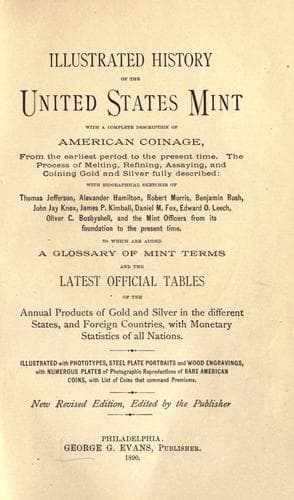
Illustrated history of the United States mint: with a complete description of American coinage, from the earliest period to the present time
History
Illustrated history of the United States mint: with a complete description of American coinage, from the earliest period to the present time
Coinage -- United States; Mints -- United States
In April, 1878, he accompanied Secretary Sherman and Attorney-General
Devens to New York, and arranged a meeting between these two members
of the Cabinet and the officers of ten of the principal banks of the
city at the National Bank of Commerce, with the view of negotiating the
sale of $50,000,000 of 4½ per cent. bonds, the avails of which were to
be used for resumption purposes. The Presidents of the banks, who were
present, gave Secretary Sherman no encouragement as to the purchase of
the bonds at the rates proposed by him. Upon the return of the Secretary
and Comptroller to the Fifth Avenue Hotel, in the evening, they were
met by August Belmont, who had a cable dispatch from the Rothschilds,
authorizing a purchase of the whole amount at a premium of one and
one-half per cent. for the account of the syndicate. Upon the following
day the Secretary and the Comptroller returned to Washington, after an
absence of three days, and the success of the negotiation was announced,
much to the chagrin of some members of the Finance Committee of the House
of Representatives, who were then bitterly opposing the scheme proposed
by the Secretary for the resumption of specie payments. This negotiation
was the first of a series of brilliant financial transactions preceding
and following resumption on January 1, 1879.
Subsequently he arranged a conference, which was held in the Treasury
at Washington, in the evening, between leading bank officials of New
York and Secretaries Sherman and Evarts, which resulted in the admission
of the Assistant Treasurer as a member of the clearing house, and the
receipt by the banks of legal tender notes on a par with gold; and in
1881, by request of President Garfield, he attended a conference in New
York between the leading financial men of the city and Secretary Windom
and Attorney-General McVeagh, which resulted in the issue and successful
negotiation of three and one-half per cent. bonds.
At the time of his resignation, Mr. Knox was the oldest officer in term
of service in the department. One of the leading financial writers in the
country, in noticing his retirement, in the _Nation_ said:
“The retirement of Mr. John Jay Knox from the office of Comptroller of
the Currency is a loss to the public service of no common kind. The
intelligence which he has brought to the complicated duties of his
office has never been surpassed in any similar station, and has not
been equalled in the particular station which he has so long filled.
The National banking system owes much of its present carefulness in
detail management to his mastery of all the facts and principles of
sound finance. His annual reports embrace perhaps the most complete and
satisfactory arrangement of information needful to the business-man, the
student, and the legislator that has ever been furnished in this country
on any economical subject. Mr. Knox resigns the Comptrollership to take
the Presidency of the National Bank of the Republic of New York City.”
Public-domain text, read in full here on John Shaqi.
Reviews
Reviews
No reviews yet
Be the first to share your thoughts on this work.
Elsewhere in the archive
Join the Discussion
Join the discussion
Sign in to leave a comment or review.
Sign InorCreate an account