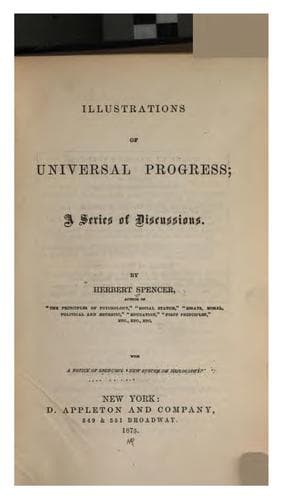
Illustrations of Universal Progress: A Series of DiscussionsSpencer, Herbert
Philosophy
Illustrations of Universal Progress: A Series of Discussions
Spencer, Herbert
Philosophy; Political science; Science
And this indeed is the fatal mischief which these conventions entail--a
mischief to which every other is secondary. They destroy those highest of
our pleasures which they profess to subserve. All institutions are alike in
this, that however useful, and needful even, they originally were, they not
only in the end cease to be so, but become detrimental. While humanity is
growing, they continue fixed; daily get more mechanical and unvital; and by
and by tend to strangle what they before preserved. It is not simply that
they become corrupt and fail to act; they become obstructions. Old forms of
government finally grow so oppressive, that they must be thrown off even at
the risk of reigns of terror. Old creeds end in being dead formulas, which
no longer aid but distort and arrest the general mind; while the
State-churches administering them, come to be instruments for subsidizing
conservatism and repressing progress. Old schemes of education, incarnated
in public schools and colleges, continue filling the heads of new
generations with what has become relatively useless knowledge, and, by
consequence, excluding knowledge which is useful. Not an organization of
any kind--political, religious, literary, philanthropic--but what, by its
ever-multiplying regulations, its accumulating wealth, its yearly addition
of officers, and the creeping into it of patronage and party feeling,
eventually loses its original spirit, and sinks into a mere lifeless
mechanism, worked with a view to private ends--a mechanism which not merely
fails of its first purpose, but is a positive hindrance to it.
Thus is it, too, with social usages. We read of the Chinese that they have
"ponderous ceremonies transmitted from time immemorial," which make social
intercourse a burden. The court forms prescribed by monarchs for their own
exaltation, have, in all times and places, ended in consuming the comfort
of their lives. And so the artificial observances of the dining-room and
saloon, in proportion as they are many and strict, extinguish that
agreeable communion which they were originally intended to secure. The
dislike with which people commonly speak of society that is "formal," and
"stiff," and "ceremonious," implies the general recognition of this fact;
and this recognition, logically developed, involves that all usages of
behaviour which are not based on natural requirements, are injurious. That
these conventions defeat their own ends is no new assertion. Swift,
criticising the manners of his day, says--"Wise men are often more uneasy
at the over-civility of these refiners than they could possibly be in the
conversation of peasants and mechanics."
Public-domain text, read in full here on John Shaqi.
Reviews
Reviews
No reviews yet
Be the first to share your thoughts on this work.
Elsewhere in the archive
Join the Discussion
Join the discussion
Sign in to leave a comment or review.
Sign InorCreate an account