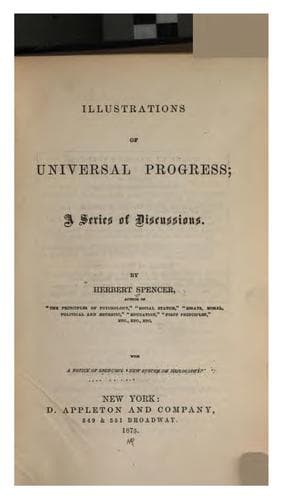
Illustrations of Universal Progress: A Series of DiscussionsSpencer, Herbert
Philosophy
Illustrations of Universal Progress: A Series of Discussions
Spencer, Herbert
Philosophy; Political science; Science
By such "consequentlys" and "therefores" it is, that men philosophize when
they "re-think the great thought of creation." By dogmas that pretend to be
reasons, nothing is made to generate mathematics; and by clothing
mathematics with matter, we have the universe! If now we deny, as we _do_
deny, that the highest mathematical idea is the zero;--if, on the other
hand, we assert, as we _do_ assert, that the fundamental idea underlying
all mathematics, is that of equality; the whole of Oken's cosmogony
disappears. And here, indeed, we may see illustrated, the distinctive
peculiarity of the German method of procedure in these matters--the bastard
_a priori_ method, as it may be termed. The legitimate _a priori_ method
sets out with propositions of which the negation is inconceivable; the _a
priori_ method as illegitimately applied, sets out either with propositions
of which the negation is _not_ inconceivable, or with propositions like
Oken's, of which the _affirmation_ is inconceivable.
It is needless to proceed further with the analysis; else might we detail
the steps by which Oken arrives at the conclusions that "the planets are
coagulated colours, for they are coagulated light; that the sphere is the
expanded nothing;" that gravity is "a weighty nothing, a heavy essence,
striving towards a centre;" that "the earth is the identical, water the
indifferent, air the different; or the first the centre, the second the
radius, the last the periphery of the general globe or of fire." To comment
on them would be nearly as absurd as are the propositions themselves. Let
us pass on to another of the German systems of knowledge--that of Hegel.
The simple fact that Hegel puts Jacob B[oe]hme on a par with Bacon,
suffices alone to show that his stand-point is far remote from the one
usually regarded as scientific: so far remote, indeed, that it is not easy
to find any common basis on which to found a criticism. Those who hold that
the mind is moulded into conformity with surrounding things by the agency
of surrounding things, are necessarily at a loss how to deal with those,
who, like Schelling and Hegel, assert that surrounding things are
solidified mind--that Nature is "petrified intelligence." However, let us
briefly glance at Hegel's classification. He divides philosophy into three
parts:--
1. _Logic_, or the science of the idea in itself, the pure idea.
2. _The Philosophy of Nature_, or the science of the idea considered
under its other form--of the idea as Nature.
3. _The Philosophy of the Mind_, or the science of the idea in its
return to itself.
Of these, the second is divided into the natural sciences, commonly so
called; so that in its more detailed form the series runs thus:--Logic,
Mechanics, Physics, Organic Physics, Psychology.
Public-domain text, read in full here on John Shaqi.
Reviews
Reviews
No reviews yet
Be the first to share your thoughts on this work.
Elsewhere in the archive
Join the Discussion
Join the discussion
Sign in to leave a comment or review.
Sign InorCreate an account