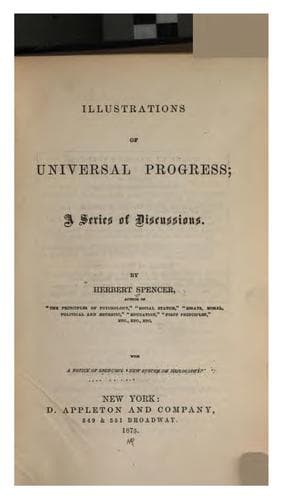
Illustrations of Universal Progress: A Series of DiscussionsSpencer, Herbert
Philosophy
Illustrations of Universal Progress: A Series of Discussions
Spencer, Herbert
Philosophy; Political science; Science
Mankind find themselves unable to conceive that there can be thought
without things thought of. Hegel, however, asserts that there _can_ be
thought without things thought of. That ultimate test of a true
proposition--the inability of the human mind to conceive the negation of
it--which in all other cases he considers valid, he considers invalid where
it suits his convenience to do so; and yet at the same time denies the
right of an opponent to follow his example. If it is competent for him to
posit dogmas, which are the direct negations of what human consciousness
recognises; then is it also competent for his antagonists to stop him at
every step in his argument by saying, that though the particular inference
he is drawing seems to his mind, and to all minds, necessarily to follow
from the premises, yet it is not true, but the contrary inference is true.
Or, to state the dilemma in another form:--If he sets out with
inconceivable propositions, then may he with equal propriety make all his
succeeding propositions inconceivable ones--may at every step throughout
his reasoning draw exactly the opposite conclusion to that which seems
involved.
Hegel's mode of procedure being thus essentially suicidal, the Hegelian
classification which depends upon it, falls to the ground. Let us consider
next that of M. Comte.
As all his readers must admit, M. Comte presents us with a scheme of the
sciences which, unlike the foregoing ones, demands respectful
consideration. Widely as we differ from him, we cheerfully bear witness to
the largeness of his views, the clearness of his reasoning, and the value
of his speculations as contributing to intellectual progress. Did we
believe a serial arrangement of the sciences to be possible, that of M.
Comte would certainly be the one we should adopt. His fundamental
propositions are thoroughly intelligible; and if not true, have a great
semblance of truth. His successive steps are logically co-ordinated; and he
supports his conclusions by a considerable amount of evidence--evidence
which, so long as it is not critically examined, or not met by counter
evidence, seems to substantiate his positions. But it only needs to assume
that antagonistic attitude which _ought_ to be assumed towards new
doctrines, in the belief that, if true, they will prosper by conquering
objectors--it needs but to test his leading doctrines either by other facts
than those he cites, or by his own facts differently applied, to at once
show that they will not stand. We will proceed thus to deal with the
general principle on which he bases his hierarchy of the sciences.
Public-domain text, read in full here on John Shaqi.
Reviews
Reviews
No reviews yet
Be the first to share your thoughts on this work.
Elsewhere in the archive
Join the Discussion
Join the discussion
Sign in to leave a comment or review.
Sign InorCreate an account