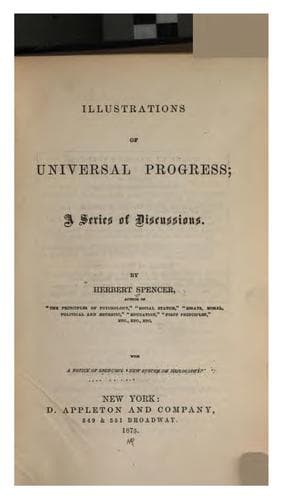
Illustrations of Universal Progress: A Series of DiscussionsSpencer, Herbert
Philosophy
Illustrations of Universal Progress: A Series of Discussions
Spencer, Herbert
Philosophy; Political science; Science
ordinary first." In all these cases, then, as well as at the close of the
section where he predicts that mathematicians will in time "create
procedures of _a wider generality_," M. Comte makes admissions that are
diametrically opposed to the alleged law.
In the succeeding chapters treating of the concrete department of
mathematics, we find similar contradictions. M. Comte himself names the
geometry of the ancients _special_ geometry, and that of moderns the
_general_ geometry. He admits that while "the ancients studied geometry
with reference to the _bodies_ under notice, or specially; the moderns
study it with reference to the _phenomena_ to be considered, or generally."
He admits that while "the ancients extracted all they could out of one line
or surface before passing to another," "the moderns, since Descartes,
employ themselves on questions which relate to any figure whatever." These
facts are the reverse of what, according to his theory, they should be. So,
too, in mechanics. Before dividing it into statics and dynamics, M. Comte
treats of the three laws of _motion_, and is obliged to do so; for statics,
the more _general_ of the two divisions, though it does not involve motion,
is impossible as a science until the laws of motion are ascertained. Yet
the laws of motion pertain to dynamics, the more _special_ of the
divisions. Further on he points out that after Archimedes, who discovered
the law of equilibrium of the lever, statics made no progress until the
establishment of dynamics enabled us to seek "the conditions of equilibrium
through the laws of the composition of forces." And he adds--"At this day
_this is the method universally employed_. At the first glance it does not
appear the most rational--dynamics being more complicated than statics, and
precedence being natural to the simpler. It would, in fact, be more
philosophical to refer dynamics to statics, as has since been done." Sundry
discoveries are afterwards detailed, showing how completely the development
of statics has been achieved by considering its problems dynamically; and
before the close of the section M. Comte remarks that "before hydrostatics
could be comprehended under statics, it was necessary that the abstract
theory of equilibrium should be made so general as to apply directly to
fluids as well as solids. This was accomplished when Lagrange supplied, as
the basis of the whole of rational mechanics, the single principle of
virtual velocities." In which statement we have two facts directly at
variance with M. Comte's doctrine;--first, that the simpler science,
statics, reached its present development only by the aid of the principle
of virtual velocities, which belongs to the more complex science, dynamics;
and that this "single principle" underlying all rational mechanics--this
_most general form_ which includes alike the relations of statical,
hydrostatical, and dynamical forces--was reached so late as the time of
Lagrange.
Public-domain text, read in full here on John Shaqi.
Reviews
Reviews
No reviews yet
Be the first to share your thoughts on this work.
Elsewhere in the archive
Join the Discussion
Join the discussion
Sign in to leave a comment or review.
Sign InorCreate an account