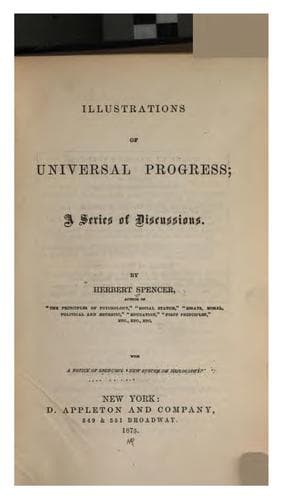
Illustrations of Universal Progress: A Series of DiscussionsSpencer, Herbert
Philosophy
Illustrations of Universal Progress: A Series of Discussions
Spencer, Herbert
Philosophy; Political science; Science
Similarly with time. Astronomical periodicity, and the periodicity of
animal and vegetable life, are simultaneously used in the first stages of
progress for estimating epochs. The simplest unit of time, the day, nature
supplies ready made. The next simplest period, the mooneth or month, is
also thrust upon men's notice by the conspicuous changes constituting a
lunation. For larger divisions than these, the phenomena of the seasons,
and the chief events from time to time occurring, have been used by early
and uncivilized races. Among the Egyptians the rising of the Nile served as
a mark. The New Zealanders were found to begin their year from the
reappearance of the Pleiades above the sea. One of the uses ascribed to
birds, by the Greeks, was to indicate the seasons by their migrations.
Barrow describes the aboriginal Hottentot as denoting periods by the number
of moons before or after the ripening of one of his chief articles of food.
He further states that the Kaffir chronology is kept by the moon, and is
registered by notches on sticks--the death of a favourite chief, or the
gaining of a victory, serving for a new era. By which last fact, we are at
once reminded that in early history, events are commonly recorded as
occurring in certain reigns, and in certain years of certain reigns: a
proceeding which practically made a king's reign a measure of duration.
And, as further illustrating the tendency to divide time by natural
phenomena and natural events, it may be noticed that even by our own
peasantry the definite divisions of months and years are but little used;
and that they habitually refer to occurrences as "before sheep-shearing,"
or "after harvest," or "about the time when the squire died." It is
manifest, therefore, that the more or less equal periods perceived in
Nature gave the first units of measure for time; as did Nature's more or
less equal lengths and weights give the first units of measure for space
and force.
It remains only to observe, as further illustrating the evolution of
quantitative ideas after this manner, that measures of value were similarly
derived. Barter, in one form or other, is found among all but the very
lowest human races. It is obviously based upon the notion of _equality of
worth_. And as it gradually merges into trade by the introduction of some
kind of currency, we find that the _measures of worth_, constituting this
currency, are organic bodies; in some cases _cowries_, in others
_cocoa-nuts_, in others _cattle_, in others _pigs_; among the American
Indians peltry or _skins_, and in Iceland _dried fish_.
Public-domain text, read in full here on John Shaqi.
Reviews
Reviews
No reviews yet
Be the first to share your thoughts on this work.
Elsewhere in the archive
Join the Discussion
Join the discussion
Sign in to leave a comment or review.
Sign InorCreate an account