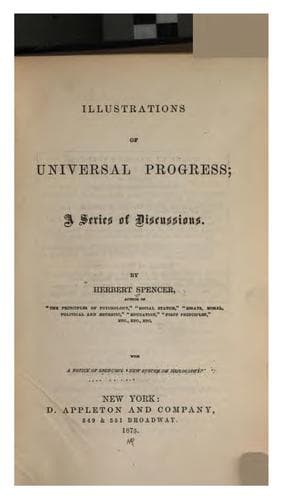
Illustrations of Universal Progress: A Series of DiscussionsSpencer, Herbert
Philosophy
Illustrations of Universal Progress: A Series of Discussions
Spencer, Herbert
Philosophy; Political science; Science
This fact, that in very early stages of social progress it is known that
the moon goes through her changes in about thirty days, and that in about
twelve moons the seasons return--this fact that chronological astronomy
assumes a certain scientific character even before geometry does; while it
is partly due to the circumstance that the astronomical divisions, day,
month, and year, are ready made for us, is partly due to the further
circumstances that agricultural and other operations were at first
regulated astronomically, and that from the supposed divine nature of the
heavenly bodies their motions determined the periodical religious
festivals. As instances of the one we have the observation of the
Egyptians, that the rising of the Nile corresponded with the heliacal
rising of Sirius; the directions given by Hesiod for reaping and ploughing,
according to the positions of the Pleiades; and his maxim that "fifty days
after the turning of the sun is a seasonable time for beginning a voyage."
As instances of the other, we have the naming of the days after the sun,
moon, and planets; the early attempts among Eastern nations to regulate the
calendar so that the gods might not be offended by the displacement of
their sacrifices; and the fixing of the great annual festival of the
Peruvians by the position of the sun. In all which facts we see that, at
first, science was simply an appliance of religion and industry.
After the discoveries that a lunation occupies nearly thirty days, and that
some twelve lunations occupy a year--discoveries of which there is no
historical account, but which may be inferred as the earliest, from the
fact that existing uncivilized races have made them--we come to the first
known astronomical records, which are those of eclipses. The Chaldeans were
able to predict these. "This they did, probably," says Dr. Whewell in his
useful history, from which most of the materials we are about to use will
be drawn, "by means of their cycle of 223 months, or about eighteen years;
for at the end of this time, the eclipses of the moon begin to return, at
the same intervals and in the same order as at the beginning." Now this
method of calculating eclipses by means of a recurring cycle,--the _Saros_
as they called it--is a more complex case of prevision by means of
coincidence of measures. For by what observations must the Chaldeans have
discovered this cycle? Obviously, as Delambre infers, by inspecting their
registers; by comparing the successive intervals; by finding that some of
the intervals were alike; by seeing that these equal intervals were
eighteen years apart; by discovering that _all_ the intervals that were
eighteen years apart were equal; by ascertaining that the intervals formed
a series which repeated itself, so that if one of the cycles of intervals
were superposed on another the divisions would fit. This once perceived,
and it manifestly became possible to use the cycle as a scale of time by
Public-domain text, read in full here on John Shaqi.
Reviews
Reviews
No reviews yet
Be the first to share your thoughts on this work.
Elsewhere in the archive
Join the Discussion
Join the discussion
Sign in to leave a comment or review.
Sign InorCreate an account