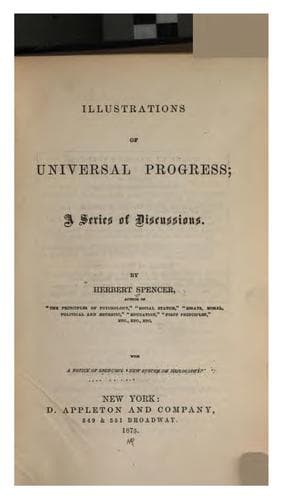
Illustrations of Universal Progress: A Series of DiscussionsSpencer, Herbert
Philosophy
Illustrations of Universal Progress: A Series of Discussions
Spencer, Herbert
Philosophy; Political science; Science
Until after optics had made considerable advance, the Copernican system
remained but a speculation. A single modern observation on a star has to
undergo a careful analysis by the combined aid of various sciences--has to
_be digested by the organism of the sciences_; which have severally to
assimilate their respective parts of the observation, before the essential
fact it contains is available for the further development of astronomy. It
has to be corrected not only for nutation of the earth's axis and for
precession of the equinoxes, but for aberration and for refraction; and the
formation of the tables by which refraction is calculated, presupposes
knowledge of the law of decreasing density in the upper atmospheric strata;
of the law of decreasing temperature, and the influence of this on the
density; and of hygrometric laws as also affecting density. So that, to get
materials for further advance, astronomy requires not only the indirect aid
of the sciences which have presided over the making of its improved
instruments, but the direct aid of an advanced optics, of barology, of
thermology, of hygrometry; and if we remember that these delicate
observations are in some cases registered electrically, and that they are
further corrected for the "personal equation"--the time elapsing between
seeing and registering, which varies with different observers--we may even
add electricity and psychology. If, then, so apparently simple a thing as
ascertaining the position of a star is complicated with so many phenomena,
it is clear that this notion of the independence of the sciences, or
certain of them, will not hold.
Whether objectively independent or not, they cannot be subjectively
so--they cannot have independence as presented to our consciousness; and
this is the only kind of independence with which we are concerned. And
here, before leaving these illustrations, and especially this last one, let
us not omit to notice how clearly they exhibit that increasingly active
_consensus_ of the sciences which characterizes their advancing
development. Besides finding that in these later times a discovery in one
science commonly causes progress in others; besides finding that a great
part of the questions with which modern science deals are so mixed as to
require the co-operation of many sciences for their solution; we find in
this last case that, to make a single good observation in the purest of the
natural sciences, requires the combined assistance of half a dozen other
sciences.
Public-domain text, read in full here on John Shaqi.
Reviews
Reviews
No reviews yet
Be the first to share your thoughts on this work.
Elsewhere in the archive
Join the Discussion
Join the discussion
Sign in to leave a comment or review.
Sign InorCreate an account