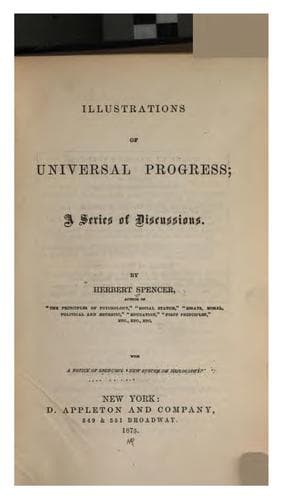
Illustrations of Universal Progress: A Series of DiscussionsSpencer, Herbert
Philosophy
Illustrations of Universal Progress: A Series of Discussions
Spencer, Herbert
Philosophy; Political science; Science
On the other hand, all are familiar with the truth that bodily activity
deadens emotion. Under great irritation we get relief by walking about
rapidly. Extreme effort in the bootless attempt to achieve a desired end,
greatly diminishes the intensity of the desire. Those who are forced to
exert themselves after misfortunes, do not suffer nearly so much as those
who remain quiescent. If any one wishes to check intellectual excitement,
he cannot choose a more efficient method than running till he is exhausted.
Moreover, these cases, in which the production of feeling and thought is
hindered by determining the nervous energy towards bodily movements, have
their counterparts in the cases in which bodily movements are hindered by
extra absorption of nervous energy in sudden thoughts and feelings. If,
when walking along, there flashes on you an idea that creates great
surprise, hope, or alarm, you stop; or if sitting cross-legged, swinging
your pendent foot, the movement is at once arrested. From the viscera, too,
intense mental action abstracts energy. Joy, disappointment, anxiety, or
any moral perturbation rising to a great height, will destroy appetite; or
if food has been taken, will arrest digestion; and even a purely
intellectual activity, when extreme, will do the like.
Facts, then, fully bear out these _a priori_ inferences, that the nervous
excitement at any moment present to consciousness as feeling, must expend
itself in some way or other; that of the three classes of channels open to
it, it must take one, two, or more, according to circumstances; that the
closure or obstruction of one, must increase the discharge through the
others; and conversely, that if to answer some demand, the efflux of
nervous energy in one direction is unusually great, there must be a
corresponding decrease of the efflux in other directions. Setting out from
these premises, let us now see what interpretation is to be put on the
phenomena of laughter.
* * * * *
That laughter is a display of muscular excitement, and so illustrates the
general law that feeling passing a certain pitch habitually vents itself in
bodily action, scarcely needs pointing out. It perhaps needs pointing out,
however, that strong feeling of almost any kind produces this result. It is
not a sense of the ludicrous, only, which does it; nor are the various
forms of joyous emotion the sole additional causes. We have, besides, the
sardonic laughter and the hysterical laughter, which result from mental
distress; to which must be added certain sensations, as tickling, and,
according to Mr. Bain, cold, and some kinds of acute pain.
Public-domain text, read in full here on John Shaqi.
Reviews
Reviews
No reviews yet
Be the first to share your thoughts on this work.
Elsewhere in the archive
Join the Discussion
Join the discussion
Sign in to leave a comment or review.
Sign InorCreate an account