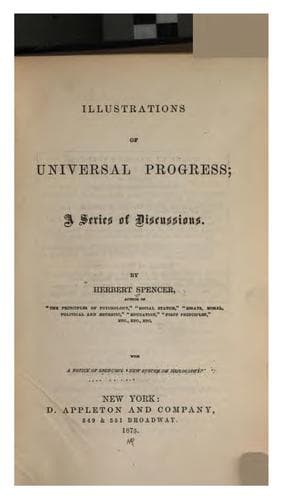
Illustrations of Universal Progress: A Series of DiscussionsSpencer, Herbert
Philosophy
Illustrations of Universal Progress: A Series of Discussions
Spencer, Herbert
Philosophy; Political science; Science
This explanation is in harmony with the fact, that when, among several
persons who witness the same ludicrous occurrence, there are some who do
not laugh; it is because there has arisen in them an emotion not
participated in by the rest, and which is sufficiently massive to absorb
all the nascent excitement. Among the spectators of an awkward tumble,
those who preserve their gravity are those in whom there is excited a
degree of sympathy with the sufferer, sufficiently great to serve as an
outlet for the feeling which the occurrence had turned out of its previous
course. Sometimes anger carries off the arrested current; and so prevents
laughter. An instance of this was lately furnished me by a friend who had
been witnessing the feats at Franconi's. A tremendous leap had just been
made by an acrobat over a number of horses. The clown, seemingly envious of
this success, made ostentatious preparation for doing the like; and then,
taking the preliminary run with immense energy, stopped short on reaching
the first horse, and pretended to wipe some dust from its haunches. In the
majority of the spectators, merriment was excited; but in my friend, wound
up by the expectation of the coming leap to a state of great nervous
tension, the effect of the baulk was to produce indignation. Experience
thus proves what the theory implies: namely, that the discharge of arrested
feelings into the muscular system, takes place only in the absence of other
adequate channels--does not take place if there arise other feelings equal
in amount to those arrested.
Evidence still more conclusive is at hand. If we contrast the incongruities
which produce laughter with those which do not, we at once see that in the
non-ludicrous ones the unexpected state of feeling aroused, though wholly
different in kind, is not less in quantity or intensity. Among
incongruities that may excite anything but a laugh, Mr. Bain instances--"A
decrepit man under a heavy burden, five loaves and two fishes among a
multitude, and all unfitness and gross disproportion; an instrument out of
tune, a fly in ointment, snow in May, Archimedes studying geometry in a
siege, and all discordant things; a wolf in sheep's clothing, a breach of
bargain, and falsehood in general; the multitude taking the law in their
own hands, and everything of the nature of disorder; a corpse at a feast,
parental cruelty, filial ingratitude, and whatever is unnatural; the entire
catalogue of the vanities given by Solomon, are all incongruous, but they
cause feelings of pain, anger, sadness, loathing, rather than mirth." Now
in these cases, where the totally unlike state of consciousness suddenly
produced, is not inferior in mass to the preceding one, the conditions to
laughter are not fulfilled. As above shown, laughter naturally results only
when consciousness is unawares transferred from great things to small--only
when there is what we call a _descending_ incongruity.
Public-domain text, read in full here on John Shaqi.
Reviews
Reviews
No reviews yet
Be the first to share your thoughts on this work.
Elsewhere in the archive
Join the Discussion
Join the discussion
Sign in to leave a comment or review.
Sign InorCreate an account