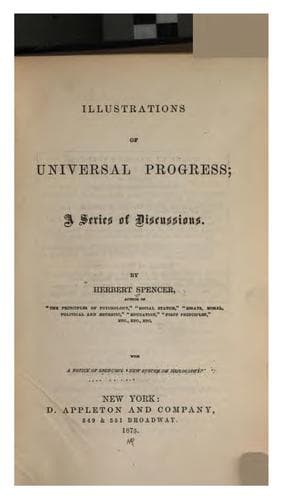
Illustrations of Universal Progress: A Series of DiscussionsSpencer, Herbert
Philosophy
Illustrations of Universal Progress: A Series of Discussions
Spencer, Herbert
Philosophy; Political science; Science
There is an antagonist hypothesis which does not propose to honour the
Unknown Power manifested in the Universe, by such titles as "The
Master-Builder," or "The Great Artificer;" but which regards this Unknown
Power as probably working after a method quite different from that of human
mechanics. And the genealogy of this hypothesis is as high as that of the
other is low. It is begotten by that ever-enlarging and ever-strengthening
belief in the presence of Law, which accumulated experiences have gradually
produced in the human mind. From generation to generation Science has been
proving uniformities of relation among phenomena which were before thought
either fortuitous or supernatural in their origin--has been showing an
established order and a constant causation where ignorance had assumed
irregularity and arbitrariness. Each further discovery of Law has increased
the presumption that Law is everywhere conformed to. And hence, among other
beliefs, has arisen the belief that the Solar System originated, not by
_manufacture_ but by _evolution_. Besides its abstract parentage in those
grand general conceptions which positive Science has generated, this
hypothesis has a concrete parentage of the highest character. Based as it
is on the law of universal gravitation, it may claim for its remote
progenitor the great thinker who established that law. The man who gave it
its general shape, by promulgating the doctrine that stars result from the
aggregation of diffused matter, was the most diligent, careful, and
original astronomical observer of modern times. And the world has not seen
a more learned mathematician than the man who, setting out with this
conception of diffused matter concentrating towards its centre of gravity,
pointed out the way in which there would arise, in the course of its
concentration, a balanced group of sun, planets, and satellites, like that
of which the Earth is a member.
Thus, even were there but little direct evidence assignable for the Nebular
Hypothesis, the probability of its truth would still be strong. Its own
high derivation and the low derivation of the antagonist hypothesis, would
together form a weighty reason for accepting it--at any rate,
provisionally. But the direct evidence assignable for the Nebular
Hypothesis is by no means little. It is far greater in quantity, and more
varied in kind, than is commonly supposed. Much has been said here and
there on this or that class of evidences; but nowhere, as far as we know,
have all the evidences, even of one class, been fully stated; and still
less has there been an adequate statement of the several groups of
evidences in their _ensemble_. We propose here to do something towards
supplying the deficiency: believing that, joined with the _a priori_
reasons given above, the array of _a posteriori_ reasons will leave little
doubt in the mind of any candid inquirer.
Public-domain text, read in full here on John Shaqi.
Reviews
Reviews
No reviews yet
Be the first to share your thoughts on this work.
Elsewhere in the archive
Join the Discussion
Join the discussion
Sign in to leave a comment or review.
Sign InorCreate an account