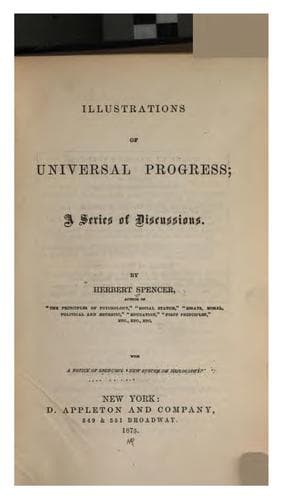
Illustrations of Universal Progress: A Series of DiscussionsSpencer, Herbert
Philosophy
Illustrations of Universal Progress: A Series of Discussions
Spencer, Herbert
Philosophy; Political science; Science
"As seen through colossal telescopes," says Humboldt, "the
contemplation of these nebulous masses leads us into regions from
whence a ray of light, according to an assumption not wholly
improbable, requires millions of years to reach our earth--to
distances for whose measurement the dimensions (the distance of
Sirius, or the calculated distances of the binary stars in Cygnus and
the Centaur) of our nearest stratum of fixed stars scarcely suffice."
Now, in this somewhat confused sentence there is expressed a more or less
decided belief, that the distances of the nebulae from our galaxy of stars
as much transcend the distances of our stars from each other, as these
interstellar distances transcend the dimensions of our planetary system.
Just as the diameter of the Earth's orbit, is an inappreciable point when
compared with the distance of our Sun from Sirius; so is the distance of
our Sun from Sirius, an inappreciable point when compared with the distance
of our galaxy from those far removed galaxies constituting nebulae. Observe
the consequences of this assumption.
If one of these supposed galaxies is so remote that its distance dwarfs our
interstellar spaces into points, and therefore makes the dimensions of our
whole sidereal system relatively insignificant; does it not inevitably
follow that the telescopic power required to resolve this remote galaxy
into stars, must be incomparably greater than the telescopic power required
to resolve the whole of our own galaxy into stars? Is it not certain that
an instrument which can just exhibit with clearness the most distant stars
of our own cluster, must be utterly unable to separate one of these remote
clusters into stars? What, then, are we to think when we find that the same
instrument which decomposes hosts of nebulae into stars, _fails_ to resolve
completely our own Milky Way? Take a homely comparison. Suppose a man
surrounded by a swarm of bees, extending, as they sometimes do, so high in
the air as to be individually almost invisible, were to declare that a
certain spot on the horizon was a swarm of bees; and that he knew it
because he could see the bees as separate specks. Astounding as the
assertion would be, it would not exceed in incredibility this which we are
criticising. Reduce the dimensions to figures, and the absurdity becomes
still more palpable. In round numbers, the distance of Sirius from the
Earth is a million times the distance of the Earth from the Sun; and,
according to the hypothesis, the distance of a nebula is something like a
million times the distance of Sirius.
Public-domain text, read in full here on John Shaqi.
Reviews
Reviews
No reviews yet
Be the first to share your thoughts on this work.
Elsewhere in the archive
Join the Discussion
Join the discussion
Sign in to leave a comment or review.
Sign InorCreate an account