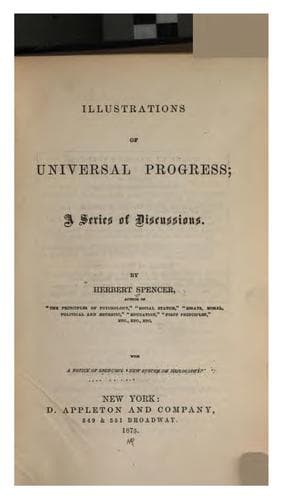
Illustrations of Universal Progress: A Series of DiscussionsSpencer, Herbert
Philosophy
Illustrations of Universal Progress: A Series of Discussions
Spencer, Herbert
Philosophy; Political science; Science
Concluding, then, that a nebulous mass will, in course of time, resolve
itself into flocculi of precipitated denser matter, floating in the rarer
medium from which they were precipitated, let us inquire what will be the
mechanical results. We shall find that they will be quite different from
those occurring in the original homogeneous mass; and also quite different
from those which would occur among discrete masses dispersed through empty
space. Bodies dispersed through empty space, would move in straight lines
towards their common centre of gravity. So, too, would bodies dispersed
through a resisting medium, provided they were spherical, or of forms
presenting symmetrical faces to their lines of movement. But _irregular_
bodies dispersed through a resisting medium, will _not_ move in straight
lines towards their common centre of gravity. A mass which presents an
irregular face to its line of movement through a resisting medium, must
necessarily be deflected from its original course, by the unequal reactions
of the medium on its different sides. Hence each _flocculus_, as by analogy
we term one of these precipitated masses of gas or vapour, will acquire a
movement, not towards the common centre of gravity, but towards one or
other side of it; and this oblique movement, accelerated as well as changed
in direction by the increasing centripetal force, but retarded by the
resisting medium, will result in a spiral, ending in the common centre of
gravity. Observe, however, that this conclusion, valid as far as it goes,
by no means proves a common spiral movement of all the flocculi; for as
they must not only be varied in their forms, but disposed in all varieties
of position, their respective movements will be deflected, not towards one
side of the common centre of gravity, but towards various sides. How then
can there result a spiral movement common to them all? Very simply. Each
flocculus, in describing its spiral course, must give motion to the rarer
medium through which it is moving.
Now, the probabilities are infinity to one against all the respective
motions thus impressed on this rarer medium, exactly balancing each other.
And if they do not balance each other, the inevitable result must be a
rotation of the whole mass of the rarer medium in one direction. But
preponderating momentum in one direction, having caused rotation of the
medium in that direction, the rotating medium must in its turn gradually
arrest such flocculi as are moving in opposition, and impress its own
motion upon them; and thus there will ultimately be formed a rotating
medium with suspended flocculi partaking of its motion, while they move in
converging spirals towards the common centre of gravity.
Public-domain text, read in full here on John Shaqi.
Reviews
Reviews
No reviews yet
Be the first to share your thoughts on this work.
Elsewhere in the archive
Join the Discussion
Join the discussion
Sign in to leave a comment or review.
Sign InorCreate an account