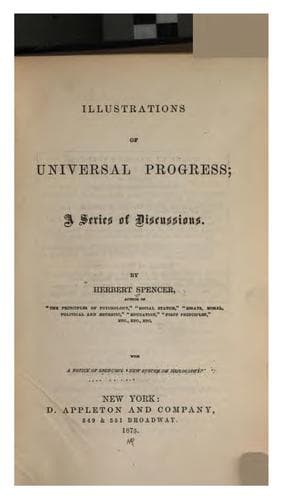
Illustrations of Universal Progress: A Series of DiscussionsSpencer, Herbert
Philosophy
Illustrations of Universal Progress: A Series of Discussions
Spencer, Herbert
Philosophy; Political science; Science
[K] It is alike remarkable and suggestive, that a parallel relation
exists between the distribution of nebulae and the axis of our
galaxy. Just as comets are abundant around the poles of our Solar
System, and rare in the neighbourhood of its plane: so are nebulae
abundant around the poles of our sidereal system, and rare in the
neighbourhood of its plane.
See, then, how differently this class of phenomena bears on the
antagonistic hypotheses. To the hypothesis commonly received, comets are
stumbling-blocks: why there should be hundreds (or probably thousands) of
extremely rare aeriform masses rushing to and fro round the sun, it cannot
say; any more than it can explain their physical constitutions, their
various and eccentric movements, or their distribution. The hypothesis of
evolution, on the other hand, not only allows of the general answer, that
they are minor results of the genetic process; but also furnishes us with
something like explanations of their several peculiarities.
* * * * *
And now, leaving these erratic bodies, let us turn to the more familiar and
important members of the Solar System. It was the remarkable harmony
subsisting among their movements, which first made Laplace conceive that
the sun, planets, and satellites had resulted from a common genetic
process. As Sir William Herschel, by his observations on the nebulae, was
led to the conclusion that stars resulted from the aggregation of diffused
matter; so Laplace, by his observations on the structure of the Solar
System, was led to the conclusion that only by the rotation of aggregating
matter were its peculiarities to be explained. In his "Exposition du
Systeme du Monde," he enumerates as the leading evidences of evolution:--1.
The movements of the planets in the same direction and almost in the same
plane; 2. The movements of the satellites in the same direction as those of
the planets; 3. The movement of rotation of these various bodies and of the
sun in the same direction as the orbitual motions, and in planes little
different; 4. The small eccentricity of the orbits of the planets and
satellites, as contrasted with the great eccentricity of the cometary
orbits. And the probability that these harmonious movements had a common
cause, he calculates as two hundred thousand billions to one.
Public-domain text, read in full here on John Shaqi.
Reviews
Reviews
No reviews yet
Be the first to share your thoughts on this work.
Elsewhere in the archive
Join the Discussion
Join the discussion
Sign in to leave a comment or review.
Sign InorCreate an account