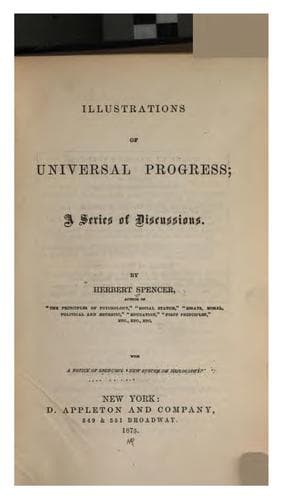
Illustrations of Universal Progress: A Series of DiscussionsSpencer, Herbert
Philosophy
Illustrations of Universal Progress: A Series of Discussions
Spencer, Herbert
Philosophy; Political science; Science
While these anomalies render untenable the position that the relative
specific gravities of the planets are direct indications of nebular
condensation; it by no means follows that they negative it. On the
contrary, we believe that the facts admit of an interpretation quite
consistent with the hypothesis of Laplace.
There are three possible causes of unlike specific gravities in the members
of our Solar System:--1. Differences between the kinds of matter or matters
composing them. 2. Differences between the quantities of matter; for, other
things equal, the mutual gravitation of atoms will make a large mass denser
than a small one. 3. Differences between the structures: the masses being
either solid or liquid throughout, or having central cavities filled with
elastic aeriform substance. Of these three conceivable causes, that
commonly assigned is the first, more or less modified by the second. The
extremely low specific gravity of Saturn, which but little exceeds that of
cork (and, on this hypothesis, must at his surface be considerably less
than that of cork) is supposed to arise from the intrinsic lightness of his
substance. That the Sun weighs not much more than an equal bulk of water,
is taken as evidence that the matter he consists of is but little heavier
than water; although, considering his enormous gravitative force, which at
his surface is twenty-eight times the gravitative force at the surface of
the Earth, and considering his enormous mass, which is 390,000 times that
of the Earth, the matter he is made of can, in such case, have no analogy
to the liquids or solids we know. However, spite of these difficulties, the
current hypothesis is, that the Sun and planets, inclusive of the Earth,
are either solid or liquid, or have solid crusts with liquid nuclei: their
unlike specific gravities resulting from unlikenesses of substance. And
indeed, at first sight, this would seem to be the only tenable supposition;
seeing that, unless prevented by some immense resisting force, gravitation
must obliterate any internal cavity by collapsing the surrounding liquid or
solid matter.
Nevertheless, that the Earth, in common with other members of the Solar
System, is solid, or else consists of a solid shell having a cavity
entirely filled with molten matter, is not an established fact: it is
nothing but a supposition. We must not let its familiarity and apparent
feasibility delude us into an uncritical acceptance of it. If we find an
alternative supposition which, physically considered, is equally possible,
we are bound to consider it. And if it not only avoids the difficulties
above pointed out, but many others hereafter to be mentioned, we must give
it the preference.
Public-domain text, read in full here on John Shaqi.
Reviews
Reviews
No reviews yet
Be the first to share your thoughts on this work.
Elsewhere in the archive
Join the Discussion
Join the discussion
Sign in to leave a comment or review.
Sign InorCreate an account