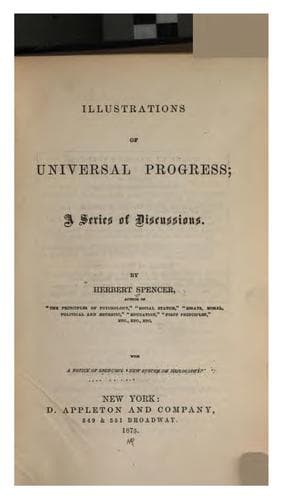
Illustrations of Universal Progress: A Series of DiscussionsSpencer, Herbert
Philosophy
Illustrations of Universal Progress: A Series of Discussions
Spencer, Herbert
Philosophy; Political science; Science
transfer of matter from the centre, by way of the poles, to the equator,
must be the establishment of counter-currents from the equator in
diametrical lines, to the centre.
Mark now the changes of temperature that must occur in these currents. An
aeriform mass ascending from the centre towards either pole, will expand as
it approaches the surface, in consequence of the diminution of pressure.
But expansion, involving an absorption of heat, will entail a diminished
temperature; and the temperature will be further lowered by the greater
freedom of radiation into space. This rarefied and cooled mass must be
still more rarefied and cooled in its progress over the surface of the
spheroid to the equator. Continually thrust further from the pole by the
ceaseless accumulation there, it must acquire an ever-increasing rotatory
motion and an ever-increasing centrifugal force: whence must follow
expansion and absorption of heat. To the refrigeration thus caused must be
added that resulting from radiation, which, at each advance towards the
equator, will be less hindered. And when the mass we have thus followed
arrives at the equator, it will have reached its maximum rarity and maximum
coolness. Conversely, every portion of a current proceeding in a
diametrical direction from the equator to the centre, must progressively
rise in temperature; in virtue alike of the increasing pressure, the
gradual arrest of motion, and the diminished rate of radiation. Note,
lastly, that this circulation will go on, but slowly. As the matter
proceeding from the equator towards the centre must have its rotatory
motion destroyed, while that proceeding from the poles to the equator must
have rotatory motion given to it, it follows that an enormous amount of
inertia has to be overcome; and this must make the currents so slow as to
prevent them from producing anything like an equality of temperature.
Such being the constitution of a concentrating spheroid of gaseous matter,
where will the gaseous matter begin to condense into liquid? The usual
assumption has been, that in a nebulous mass approaching towards the
planetary form, the liquefaction will first occur at the centre. We believe
this assumption is inconsistent with established physical principles.
Observe first that it is contrary to analogy. That the matter of the Earth
was liquid before any of it became solid, is generally admitted. Where has
it first solidified? Not at the centre, but at the surface. Now the general
principles which apply to the condensation of liquid matter into solid,
apply also to the condensation of gaseous matter into liquid. Hence if the
once liquid substance of the Earth first solidified at the surface, the
implication is that its once aeriform substance first liquified at the
surface.
Public-domain text, read in full here on John Shaqi.
Reviews
Reviews
No reviews yet
Be the first to share your thoughts on this work.
Elsewhere in the archive
Join the Discussion
Join the discussion
Sign in to leave a comment or review.
Sign InorCreate an account