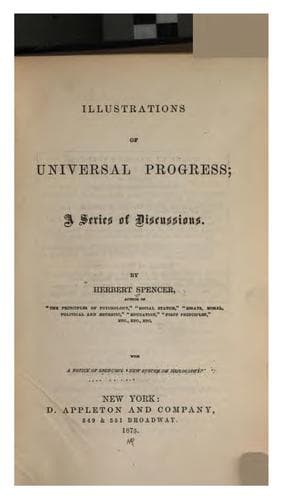
Illustrations of Universal Progress: A Series of DiscussionsSpencer, Herbert
Philosophy
Illustrations of Universal Progress: A Series of Discussions
Spencer, Herbert
Philosophy; Political science; Science
[Q] The formation of Saturn's rings is thus rendered comprehensible.
The internal circulation we have described, continuing, as it must, after
the formation of this liquid film, there will still go on the radiation of
heat, and the progressive aggregation. The film will thicken at the expense
of the internal gaseous substances precipitated on it. As it thickens, as
the globe contracts, and as the gravitative force augments, the pressure
will increase; and the evolution and radiation of heat will go on more
rapidly. Eventually, however, when the liquid shell becomes very thick, and
the internal cavity relatively small, the obstacle put to the escape of
heat by this thick liquid shell, with its slowly-circulating currents, will
turn the scale: the temperature of the outer surface will begin to
diminish, and a solid crust will form while the internal cavity is yet
unobliterated.
"But what," it may be asked, "will become of this gaseous nucleus when
exposed to the enormous gravitative pressure of a shell some thousands of
miles thick? How can aeriform matter withstand such a pressure?" Very
readily. It has been proved that even when the heat generated by
compression is allowed to escape, some gases remain uncondensible by any
force we can produce. An unsuccessful attempt lately made at Vienna to
liquify oxygen, clearly shows this enormous resistance. The steel piston
employed was literally shortened by the pressure used: and yet the gas
remained unliquified! If, then, the expansive force is thus immense when
the heat evolved is dissipated, what must it be when that heat is in great
measure detained; as in the case we are considering? Indeed, the
experiments of M. Cagniard de Latour have shown that gases may, under
pressure, acquire the density of liquids while retaining the aeriform
state; provided the temperature continues extremely high. In such a case,
every addition to the heat is an addition to the repulsive power of the
atoms: the increased pressure itself generates an increased ability to
resist; and this remains true to whatever extent the compression is
carried. Indeed, it is a corollary from the persistence of force, that if,
under increasing pressure, a gas retains all the heat evolved, its
resisting force is _absolutely unlimited_. Hence, the internal planetary
structure we have described, is as physically stable a one as that commonly
assumed.
Public-domain text, read in full here on John Shaqi.
Reviews
Reviews
No reviews yet
Be the first to share your thoughts on this work.
Elsewhere in the archive
Join the Discussion
Join the discussion
Sign in to leave a comment or review.
Sign InorCreate an account