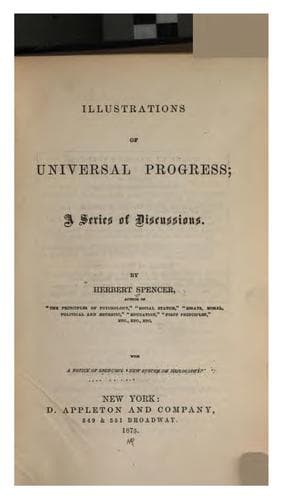
Illustrations of Universal Progress: A Series of DiscussionsSpencer, Herbert
Philosophy
Illustrations of Universal Progress: A Series of Discussions
Spencer, Herbert
Philosophy; Political science; Science
This difficulty being as we think, satisfactorily met, we go on to name
some highly significant facts giving indirect support to our hypothesis.
And first with respect to the asteroids, or planetoids, as they are
otherwise called. Now that these have proved to be so numerous--now that it
has become probable that beyond some sixty already discovered there are
many more--the supposition of Olbers, that they are the fragments of an
exploded planet which once occupied the vacant region they fill, has gained
increased probability. The alternative supposition of Laplace, that they
are the products of a nebulous ring which separated into many fragments
instead of collapsing into a single mass, seems inconsistent with the
extremely various, and in some cases extremely great, inclinations of their
orbits; as well as with their similarly various and great eccentricities.
For these the theory of Olbers completely accounts--indeed, it necessarily
involves them; while at the same time it affords us a feasible explanation
of meteors, and especially the periodic swarms of them, which would else be
inexplicable. The fact, inferred from the present derangement of their
orbits, that if the planetoids once formed parts of one mass, it must have
exploded myriads of years ago, is no difficulty, but rather the reverse.
Taking Olbers' supposition, then, as the most tenable one, let us ask how
such an explosion could have occurred. If planets are internally
constituted as is commonly assumed, no conceivable cause of it can be
named. A solid mass may crack and fall to pieces, but it cannot violently
explode. So, too, with a liquid mass covered by a crust. Though, if
contained in an unyielding shell and artificially raised to a very high
temperature, a liquid might so expand as to burst the shell and
simultaneously flash into vapour; yet, if contained in a yielding crust,
like that of a planet, it would not do so: it would crack the crust and
give off its expansive force gradually. But the planetary structure above
supposed, supplies us with all the requisite conditions to an explosion,
and an adequate cause for it. We have in the interior of the mass, a cavity
serving as a sufficient reservoir of force. We have this cavity filled with
gaseous matters of high tension. We have in the chemical affinities of
these matters a source of enormous expansive power--power capable of being
quite suddenly liberated. And we have in the increasing heat of the shell,
consequent on progressing concentration, a cause of such instantaneous
chemical change and the resulting explosion. The explanation thus supplied,
of an event which there can be little doubt has occurred, and which is not
otherwise accounted for, adds to the probability of the hypothesis.
Public-domain text, read in full here on John Shaqi.
Reviews
Reviews
No reviews yet
Be the first to share your thoughts on this work.
Elsewhere in the archive
Join the Discussion
Join the discussion
Sign in to leave a comment or review.
Sign InorCreate an account