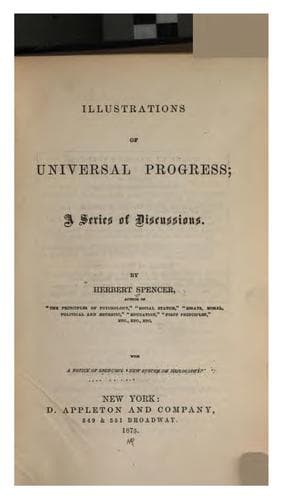
Illustrations of Universal Progress: A Series of DiscussionsSpencer, Herbert
Philosophy
Illustrations of Universal Progress: A Series of Discussions
Spencer, Herbert
Philosophy; Political science; Science
We think not; and had Mr. Bain carried farther an idea with which he has
set out, he would probably have seen that they cannot. As already said, he
avowedly adopts "the natural-history-method:" not only referring to it in
his preface, but in his first chapter giving examples of botanical and
zoological classifications, as illustrating the mode in which he proposes
to deal with the emotions. This we conceive to be a philosophical
conception; and we have only to regret that Mr. Bain has overlooked some of
its most important implications. For in what has essentially consisted the
progress of natural-history-classification? In the abandonment of grouping
by external, conspicuous characters; and in the making of certain internal,
but all-essential characters, the bases of groups. Whales are not now
ranged along with fish, because in their general forms and habits of life
they resemble fish; but they are ranged with mammals, because the type of
their organization, as ascertained by dissection, corresponds with that of
the mammals. No longer considered as sea-weeds in virtue of their forms and
modes of growth, zoophytes are now shown, by examination of their economy,
to belong to the animal kingdom.
It is found, then, that the discovery of real relationships involves
analysis. It has turned out that the earlier classifications, guided by
general resemblances, though containing much truth, and though very useful
provisionally, were yet in many cases radically wrong; and that the true
affinities of organisms, and the true homologies of their parts, are to be
made out only by examining their hidden structures. Another fact of great
significance in the history of classification is also to be noted. Very
frequently the kinship of an organism cannot be made out even by exhaustive
analysis, if that analysis is confined to the adult structure. In many
cases it is needful to examine the structure in its earlier stages; and
even in its embryonic stage. So difficult was it, for instance, to
determine the true position of the Cirrhipedia among animals, by examining
mature individuals only, that Cuvier erroneously classed them with
Mollusca, even after dissecting them; and not until their early forms were
discovered, were they clearly proved to belong to the Crustacea. So
important, indeed, is the study of development as a means to
classification, that the first zoologists now hold it to be the only
absolute criterion.
Public-domain text, read in full here on John Shaqi.
Reviews
Reviews
No reviews yet
Be the first to share your thoughts on this work.
Elsewhere in the archive
Join the Discussion
Join the discussion
Sign in to leave a comment or review.
Sign InorCreate an account