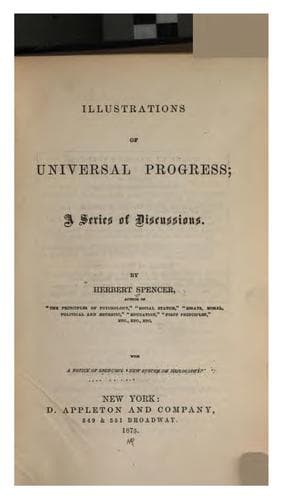
Illustrations of Universal Progress: A Series of DiscussionsSpencer, Herbert
Philosophy
Illustrations of Universal Progress: A Series of Discussions
Spencer, Herbert
Philosophy; Political science; Science
That proclivity to generalization which is possessed in greater or less
degree by all minds, and without which, indeed, intelligence cannot exist,
has unavoidable inconveniences. Through it alone can truth be reached; and
yet it almost inevitably betrays into error. But for the tendency to
predicate of every other case, that which has been found in the observed
cases, there could be no rational thinking; and yet by this indispensable
tendency, men are perpetually led to found, on limited experience,
propositions which they wrongly assume to be universal or absolute. In one
sense, however, this can scarcely be regarded as an evil; for without
premature generalizations the true generalization would never be arrived
at. If we waited till all the facts were accumulated before trying to
formulate them, the vast unorganized mass would be unmanageable. Only by
provisional grouping can they be brought into such order as to be dealt
with; and this provisional grouping is but another name for premature
generalization.
How uniformly men follow this course, and how needful the errors are as
steps to truth, is well illustrated in the history of Astronomy. The
heavenly bodies move round the Earth in circles, said the earliest
observers: led partly by the appearances, and partly by their experiences
of central motions in terrestrial objects, with which, as all circular,
they classed the celestial motions from lack of any alternative conception.
Without this provisional belief, wrong as it was, there could not have been
that comparison of positions which showed that the motions are not
representable by circles; and which led to the hypothesis of epicycles and
eccentrics. Only by the aid of this hypothesis, equally untrue, but capable
of accounting more nearly for the appearances, and so of inducing more
accurate observations--only thus did it become possible for Copernicus to
show that the heliocentric theory is more feasible than the geocentric
theory; or for Kepler to show that the planets move round the sun in
ellipses. Yet again, without the aid of this approximate truth discovered
by Kepler, Newton could not have established that general law from which it
follows, that the motion of a heavenly body round its centre of gravity is
not necessarily in an ellipse, but may be in any conic section. And lastly,
it was only after the law of gravitation had been verified, that it became
possible to determine the actual courses of planets, satellites, and
comets; and to prove that, in consequence of perturbations, their orbits
always deviate, more or less, from regular curves. Thus, there followed one
another five provisional theories of the Solar System, before the sixth and
absolutely true theory was reached. In which five provisional theories,
each for a time held as final, we may trace both the tendency men have to
leap from scanty data to wide generalizations, that are either untrue or
but partially true; and the necessity there is for these transitional
Public-domain text, read in full here on John Shaqi.
Reviews
Reviews
No reviews yet
Be the first to share your thoughts on this work.
Elsewhere in the archive
Join the Discussion
Join the discussion
Sign in to leave a comment or review.
Sign InorCreate an account