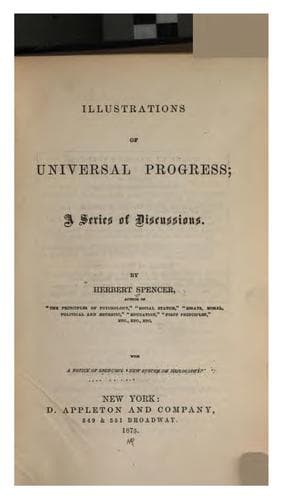
Illustrations of Universal Progress: A Series of DiscussionsSpencer, Herbert
Philosophy
Illustrations of Universal Progress: A Series of Discussions
Spencer, Herbert
Philosophy; Political science; Science
Taking for data the appearances of the Earth's crust in a narrow district
of Germany; observing the constant order of superposition of strata, and
their respective physical characters; Werner drew the inference that strata
of like characters succeeded each other in like order over the entire
surface of the Earth. And seeing, from the laminated structure of many
formations and the organic remains contained in others, that they were
sedimentary; he further inferred that these universal strata had been in
succession precipitated from a chaotic menstruum which once covered our
planet. Thus, on a very incomplete acquaintance with a thousandth part of
the Earth's crust, he based a sweeping generalization applying to the whole
of it. This Neptunist hypothesis, mark, borne out though it seemed to be by
the most conspicuous surrounding facts, was quite untenable if analyzed.
That a universal chaotic menstruum should deposit, one after another,
numerous sharply-defined strata, differing from each other in composition,
is incomprehensible. That the strata so deposited should contain the
remains of plants and animals, which could not have lived under the
supposed conditions, is still more incomprehensible. Physically absurd,
however, as was this hypothesis, it recognized, though under a distorted
form, one of the great agencies of geological change--that of water. It
served also to express the fact that the formations of the Earth's crust
stand in some kind of order. Further, it did a little towards supplying a
nomenclature, without which much progress was impossible. Lastly, it
furnished a standard with which successions of strata in various regions
could be compared, the differences noted, and the actual sections
tabulated. It was the first provisional generalization; and was useful, if
not indispensable, as a step to truer ones.
Public-domain text, read in full here on John Shaqi.
Reviews
Reviews
No reviews yet
Be the first to share your thoughts on this work.
Elsewhere in the archive
Join the Discussion
Join the discussion
Sign in to leave a comment or review.
Sign InorCreate an account