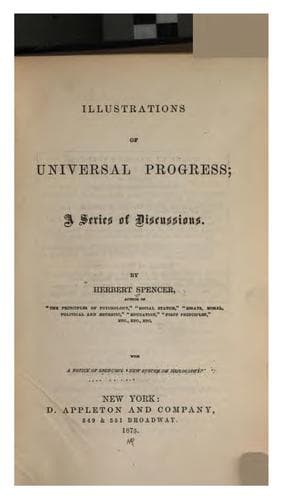
Illustrations of Universal Progress: A Series of DiscussionsSpencer, Herbert
Philosophy
Illustrations of Universal Progress: A Series of Discussions
Spencer, Herbert
Philosophy; Political science; Science
In the order of superposition of strata there is occurring a like variety.
Each region of the Earth's surface has its special history of elevations,
subsidences, periods of rest; and this history in no case fits
chronologically with the history of any other portion. River deltas are now
being thrown down on formations of quite different ages. While here there
has been deposited a series of beds many hundreds of feet thick, there has
elsewhere been deposited but a single bed of fine mud. While one region of
the Earth's crust, continuing for a vast epoch above the surface of the
ocean, bears record of no changes save those resulting from denudation;
another region of the Earth's crust gives proof of various changes of
level, with their several resulting masses of stratified detritus. If
anything is to be judged from current processes, we must infer, not only
that everywhere the succession of sedimentary formations differs more or
less from the succession elsewhere; but also that in each place, there
exist groups of strata to which many other places have no equivalents.
With respect to the organic bodies imbedded in formations now in progress,
the like truth is equally manifest, if not more manifest. Even along the
same coast, within moderate distances, the forms of life differ very
considerably; much more on coasts that are remote from each other. Again,
dissimilar creatures that are living together near the same shore, do not
leave their remains in the same beds of sediment. For instance, at the
bottom of the Adriatic, where the prevailing currents cause the deposits to
be here of mud, and there of calcareous matter, it is proved that different
species of co-existing shells are being buried in these respective
formations. On our own coasts, the marine remains found a few miles from
shore, in banks where fish congregate, are different from those found close
to the shore, where only littoral species flourish. A large proportion of
aquatic creatures have structures that do not admit of fossilization; while
of the rest, the great majority are destroyed, when dead, by the various
kinds of scavengers that creep among the rocks and weeds. So that no one
deposit near our shores can contain anything like a true representation of
the Fauna of the surrounding sea; much less of the co-existing Faunas of
other seas in the same latitude; and still less of the Faunas of seas in
distant latitudes. Were it not that the assertion seems needful, it would
be almost absurd to say, that the organic remains now being buried in the
Dogger Bank, can tell us next to nothing about the fish, crustaceans,
mollusks, and corals that are being buried in the Bay of Bengal.
Public-domain text, read in full here on John Shaqi.
Reviews
Reviews
No reviews yet
Be the first to share your thoughts on this work.
Elsewhere in the archive
Join the Discussion
Join the discussion
Sign in to leave a comment or review.
Sign InorCreate an account