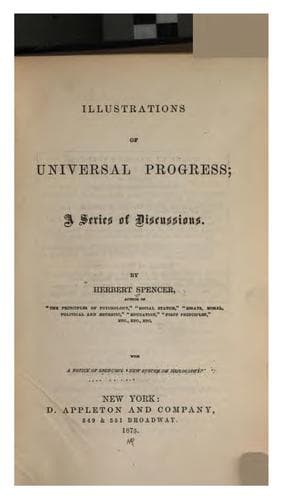
Illustrations of Universal Progress: A Series of DiscussionsSpencer, Herbert
Philosophy
Illustrations of Universal Progress: A Series of Discussions
Spencer, Herbert
Philosophy; Political science; Science
Before seeking a solution of these phenomena, let us glance at the several
minor causes that produce breaks in the geological succession of organic
forms: taking first, the more general ones which modify climate, and,
therefore, the distribution of life. Among these may be noted one which has
not, we believe, been named by writers on the subject. We mean that
resulting from a certain slow astronomic rhythm, by which the northern and
southern hemispheres are alternately subject to greater extremes of
temperature. In consequence of the slight ellipticity of its orbit, the
Earth's distance from the sun varies to the extent of some 3,000,000 of
miles. At present, the aphelion occurs at the time of our northern summer;
and the perihelion during the summer of the southern hemisphere. In
consequence, however, of that slow movement of the Earth's axis which
produces the precession of the equinoxes, this state of things will in time
be reversed: the Earth will be nearest to the sun during the summer of the
northern hemisphere, and furthest from it during the southern summer or
northern winter. The period required to complete the slow movement
producing these changes, is nearly 26,000 years; and were there no
modifying process, the two hemispheres would alternately experience this
coincidence of summer with the least distance from the sun, during a period
of 13,000 years. But there is also a still slower change in the direction
of the axis major of the Earth's orbit; from which it results that the
alternation we have described is completed in about 21,000 years. That is
to say, if at a given time the Earth is nearest to the sun at our
mid-summer, and furthest from the sun at our mid-winter: then, in 10,500
years afterwards, it will be furthest from the sun at our mid-summer, and
nearest at our mid-winter.
Public-domain text, read in full here on John Shaqi.
Reviews
Reviews
No reviews yet
Be the first to share your thoughts on this work.
Elsewhere in the archive
Join the Discussion
Join the discussion
Sign in to leave a comment or review.
Sign InorCreate an account