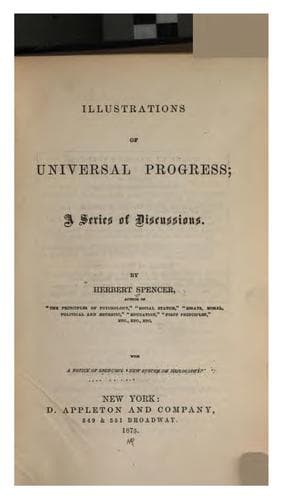
Illustrations of Universal Progress: A Series of DiscussionsSpencer, Herbert
Philosophy
Illustrations of Universal Progress: A Series of Discussions
Spencer, Herbert
Philosophy; Political science; Science
cutting tools, the substitution of bronze for stone entails upon him who
first makes it a great increase of demand--so great an increase that he
presently finds all his time occupied in making the bronze for the articles
he sells, and is obliged to depute the fashioning of these to others: and,
eventually, the making of bronze, thus gradually differentiated from a
pre-existing occupation, becomes an occupation by itself.
But now mark the ramified changes which follow this change. Bronze soon
replaces stone, not only in the articles it was first used for, but in many
others--in arms, tools, and utensils of various kinds; and so affects the
manufacture of these things. Further, it affects the processes which these
utensils subserve, and the resulting products--modifies buildings,
carvings, dress, personal decorations. Yet again, it sets going sundry
manufactures which were before impossible, from lack of a material fit for
the requisite tools. And all these changes react on the people--increase
their manipulative skill, their intelligence, their comfort,--refine their
habits and tastes. Thus the evolution of a homogeneous society into a
heterogeneous one, is clearly consequent on the general principle, that
many effects are produced by one cause.
Our limits will not allow us to follow out this process in its higher
complications: else might we show how the localization of special
industries in special parts of a kingdom, as well as the minute subdivision
of labour in the making of each commodity, are similarly determined. Or,
turning to a somewhat different order of illustrations, we might dwell on
the multitudinous changes--material, intellectual, moral,--caused by
printing; or the further extensive series of changes wrought by gunpowder.
But leaving the intermediate phases of social development, let us take a
few illustrations from its most recent and its passing phases. To trace the
effects of steam-power, in its manifold applications to mining, navigation,
and manufactures of all kinds, would carry us into unmanageable detail. Let
us confine ourselves to the latest embodiment of steam-power--the
locomotive engine.
Public-domain text, read in full here on John Shaqi.
Reviews
Reviews
No reviews yet
Be the first to share your thoughts on this work.
Elsewhere in the archive
Join the Discussion
Join the discussion
Sign in to leave a comment or review.
Sign InorCreate an account