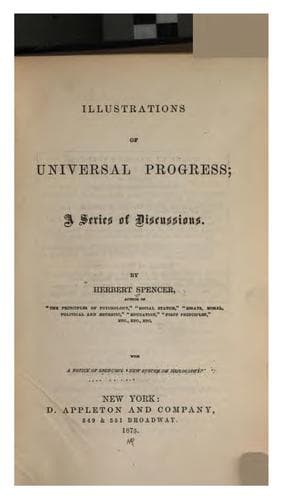
Illustrations of Universal Progress: A Series of DiscussionsSpencer, Herbert
Philosophy
Illustrations of Universal Progress: A Series of Discussions
Spencer, Herbert
Philosophy; Political science; Science
Observe now, however, that this process not only differentiates the social
mass into two parts, the one monopolizing, or almost monopolizing, the
performance of a certain function, and the other having lost the habit, and
in some measure the power, of performing that function; but it tends to
imitate other differentiations. The advance we have described implies the
introduction of barter,--the maker of weapons has, on each occasion, to be
paid in such other articles as he agrees to take in exchange. But he will
not habitually take in exchange one kind of article, but many kinds. He
does not want mats only, or skins, or fishing gear, but he wants all these;
and on each occasion will bargain for the particular things he most needs.
What follows? If among the members of the tribe there exist any slight
differences of skill in the manufacture of these various things, as there
are almost sure to do, the weapon-maker will take from each one the thing
which that one excels in making: he will exchange for mats with him whose
mats are superior, and will bargain for the fishing gear of whoever has the
best. But he who has bartered away his mats or his fishing gear, must make
other mats or fishing gear for himself; and in so doing must, in some
degree, further develop his aptitude. Thus it results that the small
specialities of faculty possessed by various members of the tribe, will
tend to grow more decided. If such transactions are from time repeated,
these specializations may become appreciable. And whether or not there
ensue distinct differentiations of other individuals into makers of
particular articles, it is clear that incipient differentiations take place
throughout the tribe: the one original cause produces not only the first
dual effect, but a number of secondary dual effects, like in kind, but
minor in degree. This process, of which traces may be seen among groups of
schoolboys, cannot well produce any lasting effects in an unsettled tribe;
but where there grows up a fixed and multiplying community, these
differentiations become permanent, and increase with each generation. A
larger population, involving a greater demand for every commodity,
intensifies the functional activity of each specialized person or class;
and this renders the specialization more definite where it already exists,
and establishes it where it is nascent. By increasing the pressure on the
means of subsistence, a larger population again augments these results;
seeing that each person is forced more and more to confine himself to that
which he can do best, and by which he can gain most. This industrial
progress, by aiding future production, opens the way for a further growth
of population, which reacts as before: in all which the multiplication of
effects is manifest. Presently, under these same stimuli, new occupations
arise. Competing workers, ever aiming to produce improved articles,
occasionally discover better processes or raw materials. In weapons and
Public-domain text, read in full here on John Shaqi.
Reviews
Reviews
No reviews yet
Be the first to share your thoughts on this work.
Elsewhere in the archive
Join the Discussion
Join the discussion
Sign in to leave a comment or review.
Sign InorCreate an account