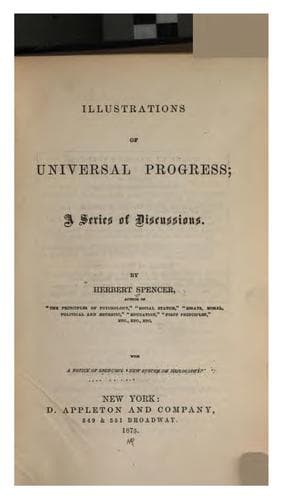
Illustrations of Universal Progress: A Series of DiscussionsSpencer, Herbert
Philosophy
Illustrations of Universal Progress: A Series of Discussions
Spencer, Herbert
Philosophy; Political science; Science
A few words must be added on the ontological bearings of our argument.
Probably not a few will conclude that here is an attempted solution of the
great questions with which Philosophy in all ages has perplexed itself. Let
none thus deceive themselves. Only such as know not the scope and the
limits of Science can fall into so grave an error. The foregoing
generalizations apply, not to the genesis of things in themselves, but to
their genesis as manifested to the human consciousness. After all that has
been said, the ultimate mystery remains just as it was. The explanation of
that which is explicable, does but bring out into greater clearness the
inexplicableness of that which remains behind. However we may succeed in
reducing the equation to its lowest terms, we are not thereby enabled to
determine the unknown quantity: on the contrary, it only becomes more
manifest that the unknown quantity can never be found.
Little as it seems to do so, fearless inquiry tends continually to give a
firmer basis to all true Religion. The timid sectarian, alarmed at the
progress of knowledge, obliged to abandon one by one the superstitions of
his ancestors, and daily finding his cherished beliefs more and more
shaken, secretly fears that all things may some day be explained; and has a
corresponding dread of Science: thus evincing the profoundest of all
infidelity--the fear lest the truth be bad. On the other hand, the sincere
man of science, content to follow wherever the evidence leads him, becomes
by each new inquiry more profoundly convinced that the Universe is an
insoluble problem. Alike in the external and the internal worlds, he sees
himself in the midst of perpetual changes, of which he can discover neither
the beginning nor the end. If, tracing back the evolution of things, he
allows himself to entertain the hypothesis that all matter once existed in
a diffused form, he finds it utterly impossible to conceive how this came
to be so; and equally, if he speculates on the future, he can assign no
limit to the grand succession of phenomena ever unfolding themselves before
him. On the other hand, if he looks inward, he perceives that both
terminations of the thread of consciousness are beyond his grasp: he cannot
remember when or how consciousness commenced, and he cannot examine the
consciousness that at any moment exists; for only a state of consciousness
that is already past can become the object of thought, and never one which
is passing.
Public-domain text, read in full here on John Shaqi.
Reviews
Reviews
No reviews yet
Be the first to share your thoughts on this work.
Elsewhere in the archive
Join the Discussion
Join the discussion
Sign in to leave a comment or review.
Sign InorCreate an account