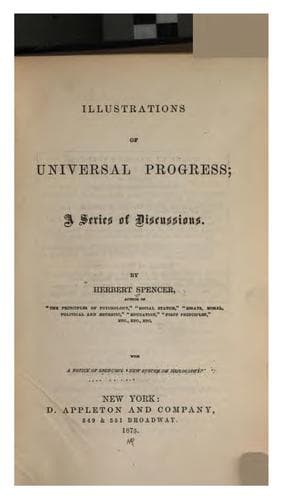
Illustrations of Universal Progress: A Series of DiscussionsSpencer, Herbert
Philosophy
Illustrations of Universal Progress: A Series of Discussions
Spencer, Herbert
Philosophy; Political science; Science
Only noting, as we pass, that this is one of those anticipations which
bring about their own fulfilment--that it is because most who disapprove
these conventions do not show their disapproval, that the few who do show
it look eccentric--and that did all act out their convictions, no such
inference as the above would be drawn, and no such evil would
result;---noting this as we pass, we go on to reply that these social
restraints, and forms, and requirements, are not small evils, but among the
greatest. Estimate their sum total, and we doubt whether they would not
exceed most others. Could we add up the trouble, the cost, the jealousies,
vexations, misunderstandings, the loss of time and the loss of pleasure,
which these conventions entail--could we clearly realize the extent to
which we are all daily hampered by them, daily enslaved by them; we should
perhaps come to the conclusion that the tyranny of Mrs. Grundy is worse
than any other tyranny we suffer under. Let us look at a few of its hurtful
results; beginning with those of minor importance.
It produces extravagance. The desire to be _comme il faut_, which underlies
all conformities, whether of manners, dress, or styles of entertainment, is
the desire which makes many a spendthrift and many a bankrupt. To "keep up
appearances," to have a house in an approved quarter furnished in the
latest taste, to give expensive dinners and crowded _soirees_, is an
ambition forming the natural outcome of the conformist spirit. It is
needless to enlarge on these follies: they have been satirized by hosts of
writers, and in every drawing-room. All that here concerns us, is to point
out that the respect for social observances, which men think so
praiseworthy, has the same root with this effort to be fashionable in mode
of living; and that, other things equal, the last cannot be diminished
without the first being diminished also. If, now, we consider all that this
extravagance entails--if we count up the robbed tradesmen, the stinted
governesses, the ill-educated children, the fleeced relatives, who have to
suffer from it--if we mark the anxiety and the many moral delinquencies
which its perpetrators involve themselves in; we shall see that this regard
for conventions is not quite so innocent as it looks.
Public-domain text, read in full here on John Shaqi.
Reviews
Reviews
No reviews yet
Be the first to share your thoughts on this work.
Elsewhere in the archive
Join the Discussion
Join the discussion
Sign in to leave a comment or review.
Sign InorCreate an account