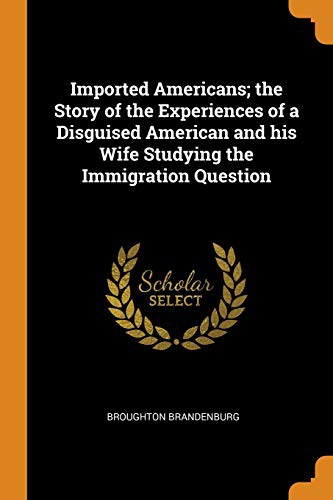
Imported Americans: The Story of the Experiences of a Disguised American and His Wife Studying the Immigration QuestionBrandenburg, Broughton
History
Imported Americans: The Story of the Experiences of a Disguised American and His Wife Studying the Immigration Question
Brandenburg, Broughton
Italy -- Emigration and immigration; United States -- Emigration and immigration
One year ago I had occasion to report that an act of Parliament had been
passed at Ottawa, to wit, Bill 112, passed by House of Commons May,
1902, designed to prevent “the landing at Canadian ports of any
immigrant or other passenger who is suffering from a loathsome,
dangerous, infectious disease or malady, whether such immigrant intends
to settle in Canada, _or only intends to pass through Canada to settle
in some other country_.”
Although this act was passed in May, 1902, it was not made effective
till September 8 of the same year. This delay was due to the absence
from Ottawa of certain government officials whose approval was essential
to its promulgation.
During the interim from the passage to the promulgation of this act a
large number of aliens destined to the United States, and a greater
number destined to Canada, were permitted to land despite the fact that
the act in question, if enforceable, would have precluded the
possibility of their landing.
Indeed, it was not until said act was made enforceable and enforced that
a single legal deportation could have been effected from Canada, so that
its promulgation may be cited as the one paramount important feature of
the year.
The Bureau having been amply apprised of the fact that the
above-mentioned Canadian legislation is due solely to revelations made
by United States immigrant inspectors on the Canadian frontier, it will
not be necessary to dwell further on that point than to emphasize the
fact that this very important matter furnishes both the Canadian and
United States governments genuine cause for gratification, inasmuch as
both are now capable of dealing satisfactorily with a very grave
question.
I felt constrained to remark in the annual report for 1902 that we must
wait for developments in order to be able to ascertain whether the
Canadian exclusion act would afford the satisfaction anticipated, and
experience has demonstrated that it was quite a proper observation to
make, because it has frequently occurred that a disagreement of
diagnoses has been determined on the Canadian medical examiner’s
certificate, which has led to certain aliens being allowed to land
instead of being deported, as would have been the case had the United
States medical examiner’s certificate been accepted as final.
However, it is a source of pleasure to me to be able to report that
while such cases were painfully numerous during the early period of the
enforcement of the Canadian exclusion act, there has been a tendency to
uniformity of diagnoses, and not only that, but also an appreciable
improvement in the conditions existing between the officers of the
immigration services, Canadian and United States, respectively.
Public-domain text, read in full here on John Shaqi.
Reviews
Reviews
No reviews yet
Be the first to share your thoughts on this work.
Elsewhere in the archive
Join the Discussion
Join the discussion
Sign in to leave a comment or review.
Sign InorCreate an account