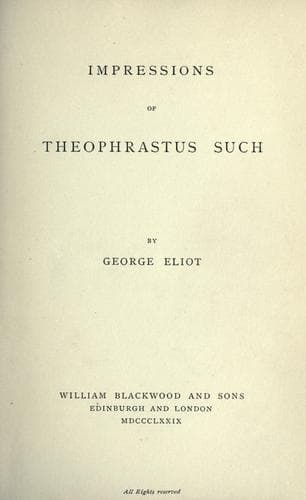
Authors -- Fiction; Character sketches; England -- Fiction
Still the historian guides us rightly in urging us to dwell on the
virtues of our ancestors with emulation, and to cherish our sense of a
common descent as a bond of obligation. The eminence, the nobleness of a
people depends on its capability of being stirred by memories, and of
striving for what we call spiritual ends--ends which consist not in
immediate material possession, but in the satisfaction of a great
feeling that animates the collective body as with one soul. A people
having the seed of worthiness in it must feel an answering thrill when
it is adjured by the deaths of its heroes who died to preserve its
national existence; when it is reminded of its small beginnings and
gradual growth through past labours and struggles, such as are still
demanded of it in order that the freedom and wellbeing thus inherited
may be transmitted unimpaired to children and children's children; when
an appeal against the permission of injustice is made to great
precedents in its history and to the better genius breathing in its
institutions. It is this living force of sentiment in common which makes
a national consciousness. Nations so moved will resist conquest with
the very breasts of their women, will pay their millions and their blood
to abolish slavery, will share privation in famine and all calamity,
will produce poets to sing "some great story of a man," and thinkers
whose theories will bear the test of action. An individual man, to be
harmoniously great, must belong to a nation of this order, if not in
actual existence yet existing in the past, in memory, as a departed,
invisible, beloved ideal, once a reality, and perhaps to be restored. A
common humanity is not yet enough to feed the rich blood of various
activity which makes a complete man. The time is not come for
cosmopolitanism to be highly virtuous, any more than for communism to
suffice for social energy. I am not bound to feel for a Chinaman as I
feel for my fellow-countryman: I am bound not to demoralise him with
opium, not to compel him to my will by destroying or plundering the
fruits of his labour on the alleged ground that he is not cosmopolitan
enough, and not to insult him for his want of my tailoring and religion
when he appears as a peaceable visitor on the London pavement. It is
admirable in a Briton with a good purpose to learn Chinese, but it
would not be a proof of fine intellect in him to taste Chinese poetry in
the original more than he tastes the poetry of his own tongue.
Affection, intelligence, duty, radiate from a centre, and nature has
decided that for us English folk that centre can be neither China nor
Peru. Most of us feel this unreflectingly; for the affectation of
undervaluing everything native, and being too fine for one's own
country, belongs only to a few minds of no dangerous leverage. What is
wanting is, that we should recognise a corresponding attachment to
nationality as legitimate in every other people, and understand that its
Public-domain text, read in full here on John Shaqi.
Reviews
Reviews
No reviews yet
Be the first to share your thoughts on this work.
Elsewhere in the archive
Join the Discussion
Join the discussion
Sign in to leave a comment or review.
Sign InorCreate an account