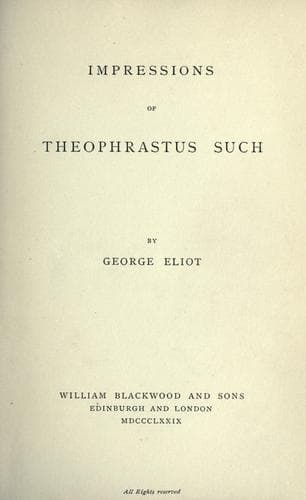
Authors -- Fiction; Character sketches; England -- Fiction
Let it be admitted that it is a calamity to the English, as to any other
great historic people, to undergo a premature fusion with immigrants of
alien blood; that its distinctive national characteristics should be in
danger of obliteration by the predominating quality of foreign settlers.
I not only admit this, I am ready to unite in groaning over the
threatened danger. To one who loves his native language, who would
delight to keep our rich and harmonious English undefiled by foreign
accent, foreign intonation, and those foreign tinctures of verbal
meaning which tend to confuse all writing and discourse, it is an
affliction as harassing as the climate, that on our stage, in our
studios, at our public and private gatherings, in our offices,
warehouses, and workshops, we must expect to hear our beloved English
with its words clipped, its vowels stretched and twisted, its phrases of
acquiescence and politeness, of cordiality, dissidence or argument,
delivered always in the wrong tones, like ill-rendered melodies, marred
beyond recognition; that there should be a general ambition to speak
every language except our mother English, which persons "of style" are
not ashamed of corrupting with slang, false foreign equivalents, and a
pronunciation that crushes out all colour from the vowels and jams them
between jostling consonants. An ancient Greek might not like to be
resuscitated for the sake of hearing Homer read in our universities,
still he would at least find more instructive marvels in other
developments to be witnessed at those institutions; but a modern
Englishman is invited from his after-dinner repose to hear Shakspere
delivered under circumstances which offer no other novelty than some
novelty of false intonation, some new distribution of strong emphasis on
prepositions, some new misconception of a familiar idiom. Well! it is
our inertness that is in fault, our carelessness of excellence, our
willing ignorance of the treasures that lie in our national heritage,
while we are agape after what is foreign, though it may be only a vile
imitation of what is native.
Public-domain text, read in full here on John Shaqi.
Reviews
Reviews
No reviews yet
Be the first to share your thoughts on this work.
Elsewhere in the archive
Join the Discussion
Join the discussion
Sign in to leave a comment or review.
Sign InorCreate an account