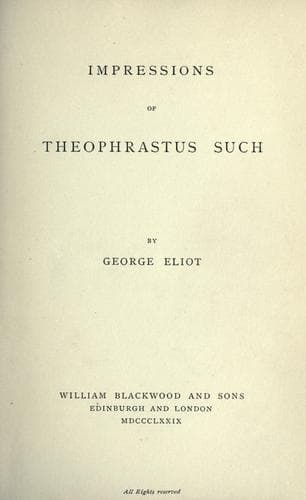
Authors -- Fiction; Character sketches; England -- Fiction
Formerly, evangelical orthodoxy was prone to dwell on the fulfilment of
prophecy in the "restoration of the Jews." Such interpretation of the
prophets is less in vogue now. The dominant mode is to insist on a
Christianity that disowns its origin, that is not a substantial growth
having a genealogy, but is a vaporous reflex of modern notions. The
Christ of Matthew had the heart of a Jew--"Go ye first to the lost
sheep of the house of Israel." The Apostle of the Gentiles had the heart
of a Jew: "For I could wish that myself were accursed from Christ for my
brethren, my kinsmen according to the flesh: who are Israelites; to whom
pertaineth the adoption, and the glory, and the covenants, and the
giving of the law, and the service of God, and the promises; whose are
the fathers, and of whom as concerning the flesh Christ came." Modern
apostles, extolling Christianity, are found using a different tone: they
prefer the mediaeval cry translated into modern phrase. But the
mediaeval cry too was in substance very ancient--more ancient than the
days of Augustus. Pagans in successive ages said, "These people are
unlike us, and refuse to be made like us: let us punish them." The Jews
were steadfast in their separateness, and through that separateness
Christianity was born. A modern book on Liberty has maintained that from
the freedom of individual men to persist in idiosyncrasies the world may
be enriched. Why should we not apply this argument to the idiosyncrasy
of a nation, and pause in our haste to hoot it down? There is still a
great function for the steadfastness of the Jew: not that he should
shut out the utmost illumination which knowledge can throw on his
national history, but that he should cherish the store of inheritance
which that history has left him. Every Jew should be conscious that he
is one of a multitude possessing common objects of piety in the immortal
achievements and immortal sorrows of ancestors who have transmitted to
them a physical and mental type strong enough, eminent enough in
faculties, pregnant enough with peculiar promise, to constitute a new
beneficent individuality among the nations, and, by confuting the
traditions of scorn, nobly avenge the wrongs done to their Fathers.
There is a sense in which the worthy child of a nation that has brought
forth illustrious prophets, high and unique among the poets of the
world, is bound by their visions.
Is bound?
Yes, for the effective bond of human action is feeling, and the worthy
child of a people owning the triple name of Hebrew, Israelite, and Jew,
feels his kinship with the glories and the sorrows, the degradation and
the possible renovation of his national family.
Will any one teach the nullification of this feeling and call his
doctrine a philosophy? He will teach a blinding superstition--the
superstition that a theory of human wellbeing can be constructed in
disregard of the influences which have made us human.
THE END.
Public-domain text, read in full here on John Shaqi.
Reviews
Reviews
No reviews yet
Be the first to share your thoughts on this work.
Elsewhere in the archive
Join the Discussion
Join the discussion
Sign in to leave a comment or review.
Sign InorCreate an account