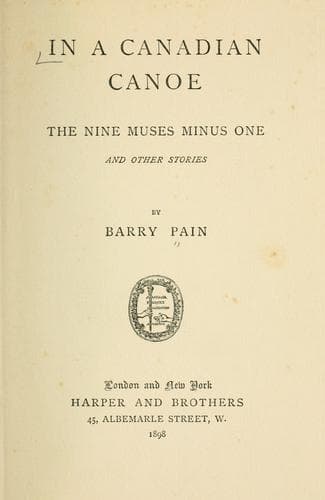
In a Canadian Canoe; The Nine Muses Minus One, and Other StoriesPain, Barry
General
In a Canadian Canoe; The Nine Muses Minus One, and Other Stories
Pain, Barry
English wit and humor
He opened the piano and took down the first piece that came. It was a
drawing-room piece, and had the entire absence of soul which always
appealed to the corresponding vacuum in the chilly Miss Dean. It was
moderately difficult, and sounded _very_ difficult. Miss Dean well
knew that when a girl like Marjorie, not yet fifteen, played that
piece properly, it would be acknowledged to reflect great credit on
her teacher. Maurice Grey opened the piece, looked at it suspiciously,
skipped the introduction, played a few bars from the first page,
glanced at the fifth page, then shut it up, and put it back again on
the top of the piano with a sigh.
“I hate that too,” said Marjorie. “Play the thing you played to them
last night in the drawing-room.”
“You weren’t in the drawing-room last night.”
“No, but my bedroom’s just above, and I could hear it. It went like
this.” She hummed a few bars.
Maurice began to play once more. It was a mischievous, tender,
eccentric little dance that went laughing about the piano as if it were
mad. Marjorie had finished her work, and rose from the table and stood
beside him, watching him with dark, attentive eyes as he played. She
was thinking that she liked Maurice. He knew the right way to treat
her. Aunt Julia treated her like a baby, and other visitors often
appeared to be under the impression that children like inanity. Her
father was rather an apathetic man, yet he had the sincerest affection
for his wife, his only daughter, and young Maurice Grey. He had many
acquaintances, but no other friends. He had been “Meyner and Sons,” who
did great things in iron, but he disposed of his business to a company
soon after his marriage. He was absorbed in the study of psychology,
and made many curious experiments upon himself. In one or two of these
young Maurice had been of some service to him. But in his family
affections, his studies, or his experiments, he showed very little
enthusiasm. He never expected to get great results. “The evidence is so
bad,” he said to Maurice once, speaking of his favourite pursuit. “On
my subject men lie often intentionally; and often deceive themselves
and lie unintentionally, and rarely speak the truth. Also I find out
more and more that I cannot even trust my own senses. The human brain
is a shockingly defective instrument.” He was a little sensitive, and
to visitors in his house--with the exception of Maurice--he would
talk of anything but psychology. Psychology, he found, was a thing
they never understood at all, and at which they generally laughed.
Marjorie’s mother, Mrs. Meyner, was not so apathetic or so pessimistic,
but then her horizon was not extended. The circle of her friends and
relations gave her enough to think about and to make life worth living.
She was a very gentle, unselfish woman, and had a provoking knack of
sincerely liking nearly everybody. Her half-sister, Julia, had the
opposite knack of hating nearly everybody. Julia was old and unmarried,
Public-domain text, read in full here on John Shaqi.
Reviews
Reviews
No reviews yet
Be the first to share your thoughts on this work.
Elsewhere in the archive
Join the Discussion
Join the discussion
Sign in to leave a comment or review.
Sign InorCreate an account