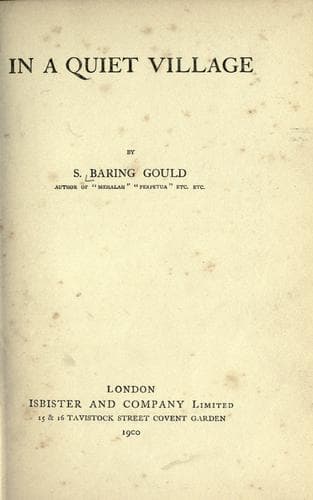
England -- Fiction; Short stories, English; Villages -- Fiction; Wales -- Fiction
“Delighted, my dear, to see you; but you do not intend to remain
long—because Christmas is at hand—the day after to-morrow—and of course
you will be back for that?”
Mrs. Birdwood looked down, and did not answer. Next morning she went to
see friends. About mid-day she returned, when she was encountered by her
aunt in the passage. “My dear—dreadful news! Have you heard?”
“Heard—no. What?”
“It comes from Jemima’s mother, your maid-of-all-work as you took from
here at my recommendation. She writ to her mother yesterday evening; and
it is shocking—orful!”
“What is it, aunt?”
Mrs. Birdwood turned white; that slavey had written that her mistress had
run away, and—doubtless with amplifications of her own—run away with a
commercial in the hosiery and haberdashery line, and had been seen with
him at a circus at Sandbourne.
“You must prepare yourself for the worst,” said the aunt.
“I know it—I know it!” gasped Mrs. Birdwood.
“I don’t see how you can, as it only happened yesterday,” said the old
lady.
“Well, tell me all—hold back nothing!”
“Your dear Josiah—he’s gone and scalded hisself to death, in trying to
bile a plum-pudding for his Christmas dinner. The flesh is come off in
collops—just like an over-boiled leg of veal—with rice, you know. Don’t
cling to th’ bone. I had a rabbit too, once——”
Mrs. Birdwood uttered a cry; she did not stay to hear about the rabbit,
but flew to the station. She was just in time to catch a train. She took
her ticket for—she asked for one to Jessamine Villa, but the clerk said
there was no such station; then she recalled the name of the town in the
outskirts of which Jessamine Villa was situated.
Weeping, trembling, sick at heart, she sat in the third-class carriage,
as she was whirled home—to the home she had left, to the husband she had
deserted.
On reaching the station where she had to disembark she flew to the villa.
From a distance she could see—the blinds were drawn down; but then it was
evening, and a lamp was alight within—was it where he was laid out in his
bones?
She burst in at the door, bathed in a dew of anguish as well as heat,
rushed into the sitting-room, and found there Mr. Birdwood in an
arm-chair by the fire, his foot up, reading a catalogue of horticultural
structures.
“Well, my dear,” said he, “back again?”
“And you—you have been scalded?”
“Yes; my foot.”
“How?”
“Jemima said she couldn’t make a Christmas plum-pudding, and I said we
must have one, so I tried my hand.”
“But the flesh—has it left the bone in collops?”
“No; I am blistered, that is all. I spilt the mess over my foot. It was
not quite on the boil, I believe.”
“Goodness me! And how did you make the mess?”
“All right—raisins and flour.”
“No suet?”
“No.”
“No mixed peel?”
“Never thought of it.”
“Any old ale?”
“Of course not.”
“Nor eggs?”
“Did not suppose they were wanted.”
“Then,” said Mrs. Birdwood, “it was a mess. I am glad it was all spilt.”
She heaved a sigh. “Oh, Josiah, how could you?”
Public-domain text, read in full here on John Shaqi.
Reviews
Reviews
No reviews yet
Be the first to share your thoughts on this work.
Elsewhere in the archive
Join the Discussion
Join the discussion
Sign in to leave a comment or review.
Sign InorCreate an account