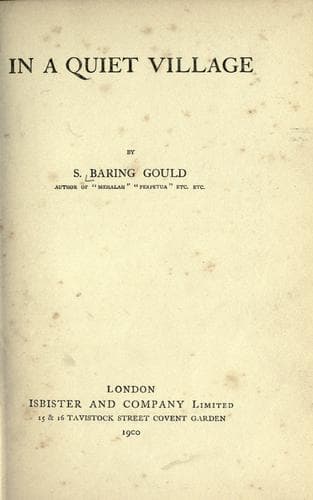
England -- Fiction; Short stories, English; Villages -- Fiction; Wales -- Fiction
Much astonishment was caused in 1837 in the West Riding of Yorkshire by a
man being committed to prison for a month with hard labour for selling or
attempting to sell his wife by auction in the manner already described.
It was generally and firmly believed that he was acting within his rights.
In 1858, in a tavern at Little Horton, near Bradford, a man named Hartley
Thomson put up his wife, who is described by the local journals as a
pretty young woman, for sale by auction, and he had the sale previously
announced by sending round the bellman. He led her into the market with a
ribbon round her neck, which exhibits an advance in refinement over the
straw halter; and again in 1859, a man at Dudley disposed of his wife in
a somewhat similar manner for sixpence. A feature in all these instances
is the docility with which the wife submits to be haltered and sold.
She would seem to have been equally imbued with the idea that there was
nothing to be ashamed of in the transaction, and that it was perfectly
legal.
If we look to see whence originated the idea, we shall probably find
it in the conception of marriage as a purchase. Among savage races, the
candidate for marriage is expected to pay the father for his daughter.
A marriageable girl is worth so many cows or so many reindeer. The man
pays over a sum of money or its equivalent to the father, and in exchange
receives the girl. If he desires to be separated from her he has no idea
of giving her away, but receives what is calculated to be her market
value from the man who is disposed to relieve him of her. In all dealings
for cattle, or horses, or sheep, a handsel is paid, half-a-crown to
clinch the bargain, and the transfer of coin constitutes a legal transfer
of authority and property over the animal. This is applied to a woman,
and when a coin, even a sixpence, is paid over and received, the receiver
regards this as releasing him from all further possession of the wife,
who at once passes under the hand of the purchaser. There is probably
no trace in our laws of women having been thus regarded as negotiable
properties, but it is unquestionable that at an early period, before
Christianity invaded the island, such a view was held, and if here and
there the rustic mind is unable to rise to a higher view of the marriage
state, it shows how extremely slow it is for opinions to alter when
education has been neglected.
MILK-MAIDS
MILK-MAIDS
It is a sad subject for reflection that, among the extinct animals, we
should have to reckon the milk-maids of Old England—the theme of so much
poetry, the subject of such charming pictures.
Public-domain text, read in full here on John Shaqi.
Reviews
Reviews
No reviews yet
Be the first to share your thoughts on this work.
Join the Discussion
Join the discussion
Sign in to leave a comment or review.
Sign InorCreate an account