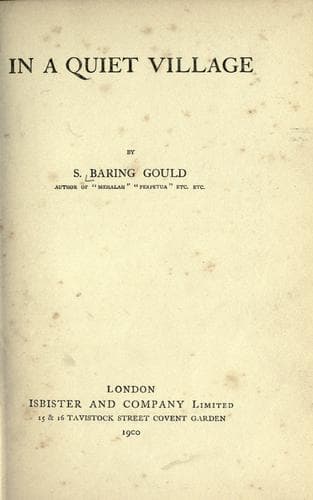
England -- Fiction; Short stories, English; Villages -- Fiction; Wales -- Fiction
It was formerly the custom for the bonny milk-maids to dance before
the houses of their customers in the month of May, to obtain a small
gratuity; and there is a dear old English tune, “The merry milk-maids in
green,” that was probably the one to which they were wont to dance. To be
a milk-maid and to be merry were synonymous terms in the olden time.
Pepys, in his diary, 13th October 1662, says, “With my father took a
melancholy walk to Portholme, seeing the country-maids milking their cows
there, they being there now at grass; and to see with what mirth they
come all home together in pomp with their milk, and sometimes they have
music go before them.”
In Beaumont and Fletcher’s play, “The Coxcomb,” printed in 1647, two
milk-maids are introduced, Nan and Madge, and the scene in which they
are on the stage is so charming, that I venture to quote a good deal of
it—the authors have so happily caught the kindliness, the simplicity, the
joyousness of the English milk-maid of yore.
But one word I must premise. Viola, the heroine of the play is astray and
wandering over the country seeking to conceal whence she is and who she
is.
Viola wearied and lost sighs—
“The evening comes and every little flower
Droops now, as well as I.”
Then enter Nan and Madge with milk pails.
“_Nan._ Good Madge,
Let’s rest a little; by my troth, I’m weary.
This new pail is a plaguy heavy one.
_Madge._ With all my heart.
_Viola (aside)._ What true contented happiness dwells here,
More than in cities! Would to God my father
Had lived like one of these, and bred me up
To milk, and do as they do. Methinks ’tis
A life that I would choose.
Maids!
For charity, give a poor wench one draught of milk,
That weariness and hunger have nigh famished!
_Nan._ If I’d but one cow’s milk in all the world
You should have some on’t: There, drink.
_Madge._ Do you dwell hereabouts?
_Viola._ No; would I did.
_Nan._ Madge, if she does not look as like my cousin Sue
O’ th’ Moor Lane, as one thing can look like another.
_Madge._ Nay; Sue has a hazel eye, I know Sue well;
And, by your leave, not so trim a body, neither;
This is a flat-bodied thing, I can tell you.
_Nan._ She laces close,
By the Mass, I warrant you; and so does Sue too.”
Then Viola entreats the two girls to find her where she may not only
lodge, but also find work.
“_Nan._ Uds me, our Dorothy went away but last week,
And I know my mistress wants a maid, and why
May she not be placed there? This is a likely wench,
I tell you truly, and a good wench, I warrant her.
_Madge._ And ’tis a hard case if we, that have served
Four years apiece, cannot bring in one servant.
We will prefer her.… Can you milk a cow?
And make a merry-bush?
_Viola._ I shall learn quickly.
_Nan._ And dress a house with flowers? and—
This you must do, for we deal in the dairy—
And make a bed or two?
Public-domain text, read in full here on John Shaqi.
Reviews
Reviews
No reviews yet
Be the first to share your thoughts on this work.
Elsewhere in the archive
Join the Discussion
Join the discussion
Sign in to leave a comment or review.
Sign InorCreate an account