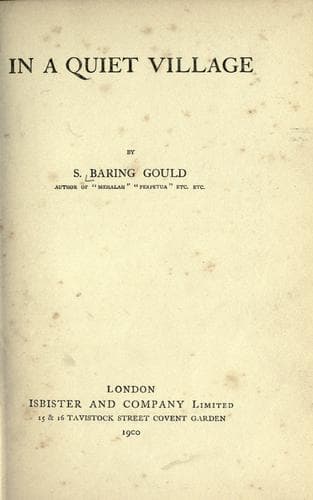
England -- Fiction; Short stories, English; Villages -- Fiction; Wales -- Fiction
_Viola._ I hope I shall.
_Nan._ But be sure to keep the men out; they will mar
All that you make else, I know that by myself;
For I have been so touz’d among ’em in
My days! Come, you shall e’en home with us,
And be our fellow; our house is honest,
And we serve a very good woman and a gentle woman,
And we live as merrily, and dance o’ good days
After evensong. Our wake shall be on Sunday;
Do you know what a wake is? we have mighty cheer then,
And such a coil, ’twould bless ye!
You must be our sister, and love us best,
And tell us everything: and when cold weather
Comes, we’ll lie together: will you do this?
_Viola._ Yes.
_Nan._ Then home again, o’ God’s name.”
We learn that Princess Elizabeth, in Queen Mary’s reign, was closely
guarded and only suffered to walk in the gardens of the palace, and not
abroad. “In this situation,” says Holingshed, “no marvell if she, hearing
upon a time out of her garden at Woodstock, a certain milk-maid singing
pleasantlie, wished herself to be a milk-maid as she was; saying that her
case was better, and life merrier.”
Sir Thomas Overbury in his “Character of a milk-maid,” in the reign of
James I., says, “She dares go alone, and unfold her sheep in the night,
and fears no manner of ill, because she means none: yet, to say truth,
she is never alone, she is still accompanied with old songs, honest
thoughts, and prayers, but short ones.”
There is still a reminiscence of the milk-maid that comes to us every
spring, in the fresh flickering cuckoo-flower of the delicate lilac,
like the pale cotton, of which the dresses of the girls were made. It
is the _Cardamine pratensis_ that bears both the name of “Milk-maids”
and “Cuckoo-flower.” The latter name it obtains, says old Gerarde,
because it “doth flower in April and Maie, when the cuckoo doth begin
to sing her pleasant notes without stammering.” The same plant is also
the “Lady’s Smock” of Shakespeare. I suppose it will retain the name
of cuckoo-flower, for the cuckoo is still with us, but lose that of
“milk-maids,” for, alas—milk-maids are no more.
The Alpine representative of the class is quite distinct. As soon as the
high pastures are free from snow, the cattle are driven up the mountains
and the women go with them. They remain at these high altitudes all the
summer till the first frosts and snows come, when they, with the cattle,
return. On the high Alps they have to milk the cows and make cheeses.
They live in _senn hüte_ (wooden hovels), and sleep in the lofts among
the hay. Here is a description by a native of the Alps.
Public-domain text, read in full here on John Shaqi.
Reviews
Reviews
No reviews yet
Be the first to share your thoughts on this work.
Elsewhere in the archive
Join the Discussion
Join the discussion
Sign in to leave a comment or review.
Sign InorCreate an account