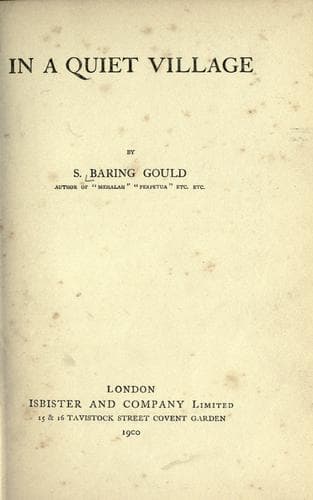
England -- Fiction; Short stories, English; Villages -- Fiction; Wales -- Fiction
When I said that the cottage was on the ramp, I was not quite exact, it
was on the slope of the hill, but ramp had been thrown up before it even
to a level above the garden, so that the dwellers in the cottage were
almost as much shut in as was Noah in his ark.
The ramp was not hideous, as new ramps are. It was so ancient that it
was overgrown with trees, and moss, and fern. The crane’s-bill loved
to ramble about it, and the wild strawberry covered it in June with a
network of rubies.
The cottage was so closed about that every wind was shut out, but the
sun flowed over it, frost rarely smote and killed the vegetables in the
garden, and flowers came there earlier than elsewhere.
A great monthly rose was trained over the front of the house, and I
believe that there were flowers on it all the year round.
Near the cottage stood a very ancient and wide-spreading oak, stunted
and contorted, because growing in a minimum of soil and a maximum of
slate rock. But in spite of disadvantages, the oak was very aged and
bore innumerable acorns. Under the shade of the tree, rained over with
shed acorns at the fall of the year, was a slab of rock, and it went by
the name of the Conjuring Table. There was a certain Lady who was fondly
believed, though dead for over a century, to haunt the parish. The story
went that Seven Parsons met at this natural table to lay the Lady’s
ghost. They would have succeeded but that one of the party was so tipsy
that he said the wrong words and forgot the right.
But that which haunted the ramp was not a ghost, it was vipers, locally
called “Long Cripples.” These creatures loved to lie in the sun on the
hot slates, and they became so comatose in the heat, or perhaps with
repletion from the number of flies and beetles they ate, that they were
easily killed there by the village lads.
Now, although the cottage was in a lonely place, and was shut in from
wind and from the sight of men, unless these latter came there purposely
to see it, yet there was that in it which precluded its being out of
mind, however much out of sight, and that was—an uncommonly pretty girl
who lived in it with her father and mother.
Their name was Worden, and her Christian name was Prue, that is to say,
Prudence.
Not only was she vastly pretty, but she was one of the happiest,
brightest dispositioned girls in the place. The sun that loved the
cottage seems to have been drunk in by her heart and to brim at her eyes.
Prue managed the beehives, of which there was a row in the garden, and
she moved among the winged creatures without their attempting to sting
her. “Talk to them, sing to them, and they become your friends,” she said.
Public-domain text, read in full here on John Shaqi.
Reviews
Reviews
No reviews yet
Be the first to share your thoughts on this work.
Elsewhere in the archive
Join the Discussion
Join the discussion
Sign in to leave a comment or review.
Sign InorCreate an account