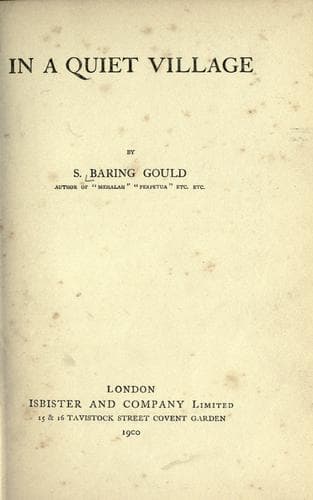
England -- Fiction; Short stories, English; Villages -- Fiction; Wales -- Fiction
“The Sennerin is engaged through the summer with tubs and churns; she
attends to the milking and the fodder. An Almbub, a little boy, is with
her, and he has to look after the herds, drive the cattle to pasture, and
bring them back at even. Both live on the boiled milk and some lard out
of a pot. Then when darkness comes on they light the _kichspan_, a bit
of firwood dipped in pitch that serves as a candle, and by its flare she
mends his torn garments which must be made to last till they return in
October; and the boy in turn takes between his knees her shoes which have
been torn in the rocks, and sews the rents with waxed thread, and tells
tales or sings songs.
“For the most part the sennerin is not under twenty. She is generally
over forty, one who has spent her life in making butter, and understands
the cows. And every summer she is aloft since she became old enough to be
trusted. Young women, the farmer knows well, do not answer on the Alpine
pastures exposed to every sort of climate and weather. And yet—sometimes,
a young one is there aloft, and then romance steps in.”
These sennerins, old, withered, for the most part, in rusty and dark
dresses, with storm and sun-tanned faces, wrinkled, eminently unpoetical
objects, how can we consider them as of the same race as our recently
extinct dairy-maids?
I will end with a couple of verses of Martin Parker’s ballad on the
Milk-maids, composed in the reign of James I. or Charles I.
“The bravest lasses gay
Live not so merry as they;
In honest civil sort
They make each other sport,
As they trudge on their way.
Come fair or foul weather,
They’re fearful of neither—
Their courages never quail:
In wet and dry, though winds be high,
And dark’s the sky, they ne’er deny
To carry the milking pail.
Their hearts are free from care,
They never will despair;
Whatever may befall,
They bravely bear out all,
And Fortune’s frowns out-dare.
They pleasantly sing
To welcome the spring—
’Gainst heaven they never rail;
If grass will grow, their shanks they show;
And, frost or snow, they merrily go
Along with the milking pail.”
THE BRIDE’S WELL
THE BRIDE’S WELL
On what is locally called a Ramp, that is to say the refuse thrown out
of a quarry, and left to decay or become covered with mould, was, in our
quiet parish, a long white-washed cottage thatched. It was planted in a
peculiar position: its back was against a dense oak wood, out of which
shot up Scotch firs, and the portion of ramp it occupied was of very
old standing, and was a good way from that part of the quarry on which
workmen were engaged.
In front of the cottage was a garden, always well kept, and on the
farther side of the garden, the inevitable pig-sty. But then—what would
the garden have produced without the pig?
Public-domain text, read in full here on John Shaqi.
Reviews
Reviews
No reviews yet
Be the first to share your thoughts on this work.
Elsewhere in the archive
Join the Discussion
Join the discussion
Sign in to leave a comment or review.
Sign InorCreate an account