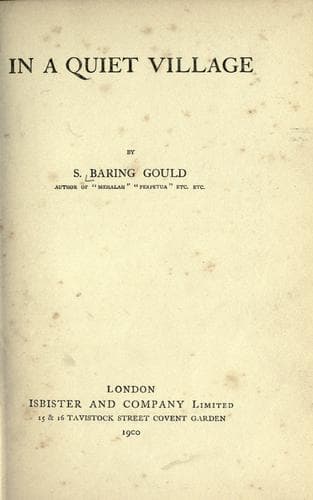
England -- Fiction; Short stories, English; Villages -- Fiction; Wales -- Fiction
In the midst of such beauty, such plenty, such softness, humanity cannot
be rough and harsh. It is not so. The simplest peasant has the courtesy
of a noble, and the lowliest girl the grace of a princess. In that warm,
soft, crumbling soil hearts are also warm, soft, and—well, we must admit
it—crumbling too.
Where Nature does so much for man, man is perhaps not greatly inclined
to do much for himself, and this applies especially to his intellectual
faculties. What compulsory education may do I cannot tell—it may change
all this; but till of late years—allow it frankly—there was astounding
ignorance in this favoured land. And with ignorance goes credulity.
Now I am going to tell of the inmates of one of these cobb cottages in
the paradisaical land of New Redsandstone, in which also paradisaical
ignorance was to be found.
This cottage, the face of which was white-washed and crept over with
monthly roses, was occupied by Richard Redlake and his wife Julia.
They were both young people. He between thirty and forty, she half-way
between twenty and thirty. Julia had been quite the prettiest girl in a
village where not a girl lived who was not pretty. She had dark hair, and
the softest, largest, most melting eyes, like rich agate, a complexion
transparent, pure, with the sweetest rose-flush in it; and her figure was
slender and willowy.
Julia could neither read nor write. Possibly because she could neither
read nor write she was a most neat and knowing housewife, who kept her
cottage in beautiful order, and whitened her hearth-stone and threshold
every day, and even twice a day, and burnished pans and candlesticks
and old mustard tins on the chimney shelf till they shone as gold and
silver. Most labourers’ wives possess the alchemical art of transforming
soft, succulent meat over a fire into leather or indiarubber, and are
peculiarly skilful in destroying the digestions of their husbands. But
Julia, perhaps because unable to read and write, turned out a bit of
steak, or the meat in a pasty, or a stew, soft and delicious.
I say that this was due to ignorance of the two principal R’s, because
nowadays working-men’s wives are too much taken up with penny dreadfuls
and writing letters on parochial gossip to be able to spare the time for
such menial work as keeping their houses neat, their own persons clean,
and cooking meals with all their attention devoted to the task.
With these good qualities there was a drawback—ignorance, abysmal
ignorance. Although Julia could not read, she believed in printed matter
as something indisputable. What stood, as she termed it, “on the paper”
was to be accepted as gospel.
For a couple of years after they were married, old Jack Hannaford, her
father, lived with the young couple. And see—here is another odd thing. I
am going to tell you about him after he was dead and buried.
Public-domain text, read in full here on John Shaqi.
Reviews
Reviews
No reviews yet
Be the first to share your thoughts on this work.
Elsewhere in the archive
Join the Discussion
Join the discussion
Sign in to leave a comment or review.
Sign InorCreate an account