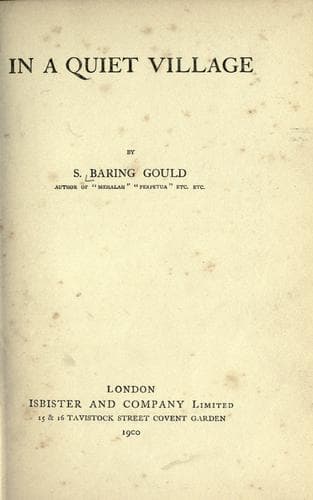
England -- Fiction; Short stories, English; Villages -- Fiction; Wales -- Fiction
The alteration of parochial boundaries by Act of Parliament has done away
with some curious anomalies that had survived from the first formation of
parishes in England—that is to say, done away with them so far as rating
is concerned, but not ecclesiastically.
The anomalies to which I refer are the odd, outlying patches, like
islets, belonging to one parish, and yet surrounded by others. There are
counties in England that have their insulated portions; and the same
is very general with regard to parishes. How this came about is not
difficult to discover. It was due to the ancient holders of estates, who
liked to have their properties united ecclesiastically. There was such a
detached patch of parish at Sugden. It was three miles from the parish
church; it was encompassed on all sides by the parish of Walmoden; but as
the story I am going to tell relates to the time before the rectification
of parochial boundaries, the cottagers of this islet were rated as
Sugdenian, and for all matters ecclesiastical looked to Sugden as their
parish church. If they wished to be married, their banns were called
at Sugden; if they were to be buried, double fees were demanded at
Walmoden, and, as the cotters were very poor, they went to lay the dust
of their kinsfolk at Sugden. Indeed, unless they had been very poor, they
would not have lived at Woodman’s Well, as the islet was called, for it
was away from the high-road, it was distant from neighbours, it consisted
of a hamlet containing two houses and a half.
The half-house was a whole cottage whose roof had fallen in, leaving,
however, one end partially covered, in which an old woman, who gathered
herbs, told fortunes, and charmed white swellings, kept up a precarious
existence under a tottering chimney. She was not alone; she had a
daughter. The two cottages were in partial collapse; their thatch was
mouldy, rotten, but not broken through, and the wooden casements were
decayed, but not in pieces. If the present tenants were to vacate these
houses, their owner believed that he would not be able to find others who
would take them and give rent for them. They had been erected on lives,
and it was probable that when they fell in to the landlord, they would
fall in altogether. By law, of course, he could insist on the holder of
the property keeping them in repair; but then, precisely, this holder was
an old man living a hundred miles away, and was impecunious; consequently
his legal right was as good as no right at all.
Those who occupied the cottages were: in the first, a mason and his wife;
that is to say, the mason was the tenant in the eye of the law, but
his occupancy was casual, and his wife saw but little of him. She was
a weakly woman, with one child, a frail little creature of two years,
a lovely child with fair hair and blue eyes. The father was fond, very
fond of his little Rosie; but he was fonder of good company at the
public-house.
Public-domain text, read in full here on John Shaqi.
Reviews
Reviews
No reviews yet
Be the first to share your thoughts on this work.
Elsewhere in the archive
Join the Discussion
Join the discussion
Sign in to leave a comment or review.
Sign InorCreate an account