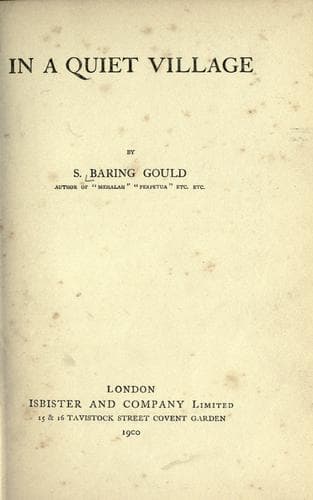
England -- Fiction; Short stories, English; Villages -- Fiction; Wales -- Fiction
He was in easy circumstances; that is to say, he had earned enough money
not to be obliged to work any longer, and had his own little house, and
could keep a “slavey.” He was inoffensive in his pursuits, being fond of
flowers, especially of roses, which he grafted; and what harm can there
be in a man who loves gardening? Next to marrying a curate, a woman
has a good certainty of her husband turning out amiable and orderly if
he grafts roses. Then, again, he was in the prime of life, by no means
bad-looking, amiable and placid. You could not study his face and not
see that he was good-humoured. On the other hand, Mrs. Birdwood was
comely, a lively woman, neat in shape, under thirty, and of a florid
complexion—which ought to suit a man addicted to flowers.
She had made a good match, said her friends, for she was one of fourteen,
and had come penniless to his arms. She had been Eliza Gubbins, and had
dropped the Gubbins at the altar. No one could deny that she was the
gainer when she acquired a name that carried with it a suggestion of
piping and tooting and whistling and jug-jugging and cooing of all kinds
of song-birds.
But there is a fly in every cup, a thorn to every rose, some bone in
every joint you get from the butcher, a cloud in every sky.
Mr. Birdwood was of an over-placid and too easy-going nature to satisfy
Mrs. Birdwood, who was impulsive, exacting, and sanguine.
He accepted connubial felicity as he did his meals—as something
anticipated, necessary, and ordinary. Instead of exhibiting an effusion
of gratitude to his wife for making him happy, he budded his roses, and
divided his bulbs, and potted his tubers as though that were the main
object of his life, instead of falling down and admiring that luminous
transcendental being who had condescended to come into Jessamine Villa to
be _his happiness_.
They had been married a twelvemonth—rather more. Eliza Gubbins had
supposed that an enamoured swain, after marriage, would grow in love,
like a conflagration, which increases as you add fuel. But it was not so;
he was warm and approving, but never rose above blood-heat. Moreover, he
had a provoking Christian name—Josiah—that he could not alter. Eliza had
fed on poetry and romance in her maiden days, and the name, Josiah, had
in it nothing poetical, no romance.
“I can’t call you Jos,” she said, “for that is the short for Joseph or
Joshua.”
“Then call me Siah.”
“Sire. No, thank you; it would seem as though I regarded you as my
sovereign.”
As yet there was no child, nor prospect of one. This fact might have been
considered a reason why they should have been more than ever devoted to
one another, as there was no distraction, no one else in the house to
love, except the slavey, and she was, naturally, out of the question.
But it was not so. Mrs. Birdwood had nothing else to think about except
the lack of ardour in Mr. Birdwood, and nothing else to do but fret over
it.
Public-domain text, read in full here on John Shaqi.
Reviews
Reviews
No reviews yet
Be the first to share your thoughts on this work.
Elsewhere in the archive
Join the Discussion
Join the discussion
Sign in to leave a comment or review.
Sign InorCreate an account