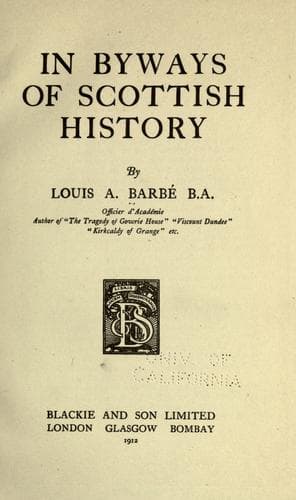
Scotland -- History -- Stuarts, to the Union, 1371-1707
In the year 1809, Robert Stevenson, engineer to the Northern Lights
Board, foreseeing that, notwithstanding the recent erection of the Bell
Rock Lighthouse, the navigation of this part of the coast would still be
very dangerous unless the light of May were improved, took an
opportunity of bringing the matter under the notice of the
Commissioners, who were not of opinion, however, that it could be taken
up by them except at the instance of the proprietor. In the following
year the question was brought into prominence by an event of serious
importance. Early in the morning of the 19th of December two of His
Majesty's ships, the frigates _Nymphen_ and _Pallas_, were wrecked near
Dunbar, in consequence, it was believed, of the fire of a limekiln on
the Haddingtonshire coast having been mistaken for the May light. The
ships were completely lost, but, the weather being moderate, only nine
men were drowned out of the joint crews of some 600. It was a remarkable
circumstance attending the catastrophe, that, although the two ships had
sailed in company, and had struck within a few miles of each other,
their similar fate was perfectly unknown to the respective crews till
late in the day.
This loss of £100,000 roused the Government to action. Lord Viscount
Melville, who was First Lord of the Admiralty at the time, applied to
the Lighthouse Board to take over the light of May as one of the
Northern Lights. In the negotiations that ensued, the Duke of Portland
proposed a scheme, in accordance with which he was to carry out the
suggested alterations, and the Commissioners were to become his lessees.
This proposal did not, however, meet with the approval of the latter,
their opinion being that the only position they could assume in the
transaction was that of purchasers for the public. The ultimate result
was the acquisition of the Isle of May, together with the light duties,
for the sum of £60,000--£3000 less than the Duke of Portland had
originally demanded. This was in 1814. That same year an Act was passed
reducing the light duty to one penny per ton for all British ships.
Immediate measures were also taken for carrying out the necessary
improvements. In the course of the following summer, a new lighthouse
was erected, and a light from oil, with reflectors, was exhibited on the
1st of February, 1816. The following official description of the new
light of May was published at the time:--
Public-domain text, read in full here on John Shaqi.
Reviews
Reviews
No reviews yet
Be the first to share your thoughts on this work.
Elsewhere in the archive
Join the Discussion
Join the discussion
Sign in to leave a comment or review.
Sign InorCreate an account