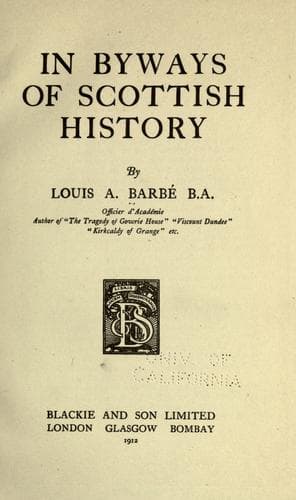
Scotland -- History -- Stuarts, to the Union, 1371-1707
THE INVASION OF AILSA CRAIG
Although in the possession of the historic family of Kennedy, to the
head of which it gives his title, Ailsa Craig, the imposing "ocean
pyramid" that rises in solitary grandeur to a height of over 1100 feet
above the waters of the Firth of Clyde, does not figure prominently in
the annals of the country, nor in the special records of the district to
which it belongs. Its whole story consists of a single episode, which,
though hardly noticed by modern historians, created some excitement,
both in Scotland and in England, at the time of its occurrence, and may
be read with interest at the present day. That incident, the invasion of
Ailsa Craig, which it is here intended to relate on the authority of
contemporary documents, takes us back to the year 1597. The chief actors
in it were Hugh Barclay, Laird of Ladylands, an Ayrshire gentleman of
good family, whose estate was situated in the neighbourhood of Irvine,
and Andrew Knox, "minister of God's worde at Paselye".
Though originally a member of the Presbyterian Church, Ladylands had
made "defectioun and apostacie fra the said trewe religioun". In the
correspondence of the time he is usually to be found figuring in the
lists of those whom it was customary to describe as "practising
Papists", a designation not undeserved in his case, for amongst the
religious enthusiasts who devoted themselves to the restoration of the
old religion none displayed a greater fixity of purpose, a more
unscrupulous contempt for the law, or a more reckless disregard of
personal danger. Andrew Knox, on the other hand, in spite of his
peaceful calling, gave proof of equal determination and equal audacity
in the fulfilment of the self-imposed mission of hunting down "Jesuitis,
seminarie preistis, and suspect trafficquaris with the King of Spain,
and utheris foreynaris". The plotting of the laird and the
counter-plotting of the minister had more than once brought the two men
into personal conflict. Indeed, so far as extant documents go, the
career of the one is practically identified with the career of the
other.
Public-domain text, read in full here on John Shaqi.
Reviews
Reviews
No reviews yet
Be the first to share your thoughts on this work.
Elsewhere in the archive
Join the Discussion
Join the discussion
Sign in to leave a comment or review.
Sign InorCreate an account