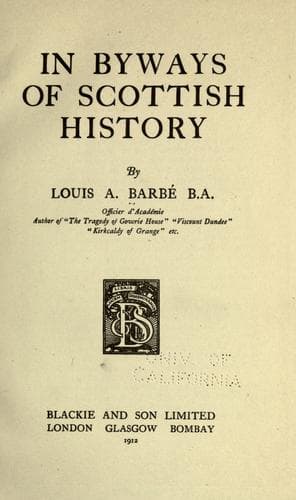
Scotland -- History -- Stuarts, to the Union, 1371-1707
The events that were chiefly instrumental in bringing the English into
either contact or conflict with Continental nations, during the Middle
Ages, were the Crusades and the Hundred Years' War. The chronicles that
deal with these are not wanting in instances from which it may be
gathered how readily the obnoxious gibe came to the lips of those that
wished to show their contempt for the islanders. Richard of Devizes, who
wrote one of the earliest and most authentic narratives of the reign of
Richard I, with whom he was contemporary, describes how, in 1190, the
inhabitants of Messina manifested their hatred for the strangers whom
the King had brought to their shores, and how they tried to wreak
vengeance on him and his "tailards"; for, explains the chronicler, the
Greeks and the Sicilians gave the name of "tailards" to all who followed
the English monarch.[296]
Another very early reference to the use of the term "tailard" as an
opprobrious synonym for "Englishmen" is that which occurs in a metrical
romance dealing with the same period and also recording, but with
poetical freedom, the life and exploits of Richard Coeur de Lion. The
exact date of the poem is unknown; but the fact of its being mentioned
in the _Chronicles_ of Richard of Gloucester and in those of Robert de
Brunne, supplies evidence of its having been written earlier than the
year 1300. It is confessedly a translation from the French; and that may
account for the appearance in it of an insulting epithet which an
English writer might have hesitated to use, even as an invective in the
mouth of an enemy. The Second Book of this romance is devoted to a
journey to the Holy Land, which the English King is supposed to have
undertaken prior to the actual crusade, but which is, however, made to
include the well-known incident of his capture. The poet tells how, when
returning from Palestine, with "Sir Foulke Doyly of renown, and Sir
Thomas of Multoun", Richard was betrayed, captured, and brought as a
prisoner before the King of Allemayne; and how, when he represented
himself and his companions as pilgrims,
"The Kyng callid Rychard be name,
And clepyd him 'taylard', and sayde him schame."[297]
In the Sixth Book of the same poem, it is related how the English King,
on his way to Acre, put in at Cyprus and sent messengers to the Emperor,
and how that monarch "began to rage", threw a knife at one of them, and
followed this up by peremptorily ordering them out of his presence, with
the words:--
"Out, 'taylards', of my paleys!
Now go and say your 'tayled' King
That I owe him no thing."[298]
When the Emperor's steward ventured to represent to his master that
such treatment of honourable knights who came to him in the character of
ambassadors was not justifiable, the furious but apocryphal potentate
"Carved off his nose by the grusle,
And said: Traytour, thief, steward,
Go, playne to English 'taylarde'."[299]
Public-domain text, read in full here on John Shaqi.
Reviews
Reviews
No reviews yet
Be the first to share your thoughts on this work.
Elsewhere in the archive
Join the Discussion
Join the discussion
Sign in to leave a comment or review.
Sign InorCreate an account