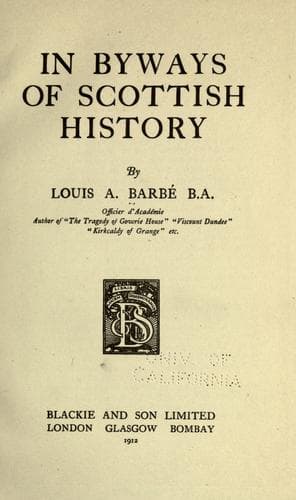
Scotland -- History -- Stuarts, to the Union, 1371-1707
The chronicles which record the events that marked the closing years of
the thirteenth century supply a grim illustration of the ignominious
treatment which their reputation as "tailards" sometimes brought upon
the English. The war which broke out about this time between Edward I
and Philip IV of France had for its cause, or, perhaps more correctly,
for its pretext, one of the brawls which frequently arose when the
sailors of the two countries met in the ports on either side of the
Channel. Whether rightly or wrongly, the Frenchmen represented the
English as the aggressors. They brought the matter under the notice of
their own king, and represented it as an insult to him and to the whole
nation that they should have been so wantonly ill-used by the
"tailards". In the reprisals which followed, Philip's brother, Charles,
took a conspicuous part. Having a previous and personal grievance
against the English, he vented his spite even on unoffending pilgrims
and students. He hanged several of the poor wretches who fell into his
hands; and, adding insult to injury, strung up dogs side by side with
them, to intimate, says the _Chronicle of Lanercost_, the resemblance
which he thought to exist between the two, or, as another record even
more plainly puts it, to show that he made no difference between a dog
and an Englishman. Amongst the State Papers relative to the history of
Edward I, there is a document which very strikingly confirms the truth
of this barbarous incident. It consists of a long roll containing an
account of the various outrages committed by the French on English
mariners and on inhabitants of the Cinque Ports. One of the charges
brought against the Norman seamen is illustrated in the margin by a
contemporaneous sketch representing a row of Englishmen hanging up, with
a dog between each two.[308]
It is suggestive of the annoyance which the English felt at their
opprobrious nickname that, when we find their writers noticing it, it is
almost invariably under provocation and in a tone of indignant protest.
One noteworthy exception to this is to be met with in a curious,
half-literary, half-historical production, attributed to John of
Bridlington. It is a political retrospect of the reign of Edward III,
and consists of a supposed ancient text, in Latin verse, with a recent
commentary on it. The poem itself purports to be a prophecy, whilst the
notes indicate in what manner the predictions were fulfilled. As the
leading event for the year 1356, the date of the battle of Poitiers, it
is foretold that,
"The four cockrels shall learn what defeat is, that day
When the French meet the English in battle array,
And the big-buttocked bullies are shamefully routed
By the men whom as 'tailards' their ribaldry flouted".[309]
Public-domain text, read in full here on John Shaqi.
Reviews
Reviews
No reviews yet
Be the first to share your thoughts on this work.
Elsewhere in the archive
Join the Discussion
Join the discussion
Sign in to leave a comment or review.
Sign InorCreate an account