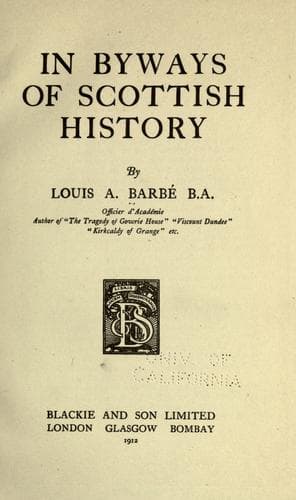
Scotland -- History -- Stuarts, to the Union, 1371-1707
In the seventeenth century, the story of the tails, which, by that time,
however, had ceased to be attributed to Englishmen at large and were
humorously regarded as distinctive of Kentish men alone, was
incidentally referred to by several poets. It supplied Sir John Mennis,
the author of _Musarum Deliceæ_, with a coarse joke. Andrew Marvel, in
his _Loyal Scot_, cites it in illustration of the danger incurred by
provoking the anger of a prelate:--
"There's no 'Deliver us' from a Bishop's wrath:
Never shall Calvin pardoned be for sales,
Never, for Burnet's sake, the Lauderdales;
For Becket's sake, Kent always shall have tails."[369]
In Drayton's _Polyolbion_, the "Blazons of the Shires", as set forth by
Helidon, open with the lines:
"Kent first in our account, doth to itself apply
(Quoth he) this Blazon first, 'Long tails and Liberty!'"[370]
Butler, in his _Hudibras_, has a couplet which declares that:
tails by nature sure were meant
As well as beards, for ornament.
According to an annotator, "Mr. Butler here alludes to Dr. Bulwer's
_Artificial Changeling_", where, besides the story of the Kentish men,
near Rochester, who had tails clapped to their breeches by Thomas à
Becket, he gives an account, on the authority of "an honest young man of
Captain Morris's company in Lieutenant-General Ireton's company", of how
"at Cashell in the County of Tipperary, in the province of Munster, in
Carrick Patrick church, seated on a hill or rock, stormed by the Lord
Inchequine, and where were neare 700 put to the sword and none saved but
the Mayor's wife and his son, there were found among the slain of the
Irish, when they were stript, divers with tailes near a quarter of a
yard long. The relator being very diffident of the truth of this story,
after enquiry was ensured of the certainty thereof by forty souldiers,
that testified upon their oaths that they were eyewitnesses, being
present at the action." With such testimony in support of his assertion
that "the rump bone among brutish and strong-docht nations doth often
spread out with such an excrescence or beastly emanation", Dr. Bulwer
is not disinclined to believe in the possession of tails by the
inhabitants of Stroud.
Public-domain text, read in full here on John Shaqi.
Reviews
Reviews
No reviews yet
Be the first to share your thoughts on this work.
Elsewhere in the archive
Join the Discussion
Join the discussion
Sign in to leave a comment or review.
Sign InorCreate an account