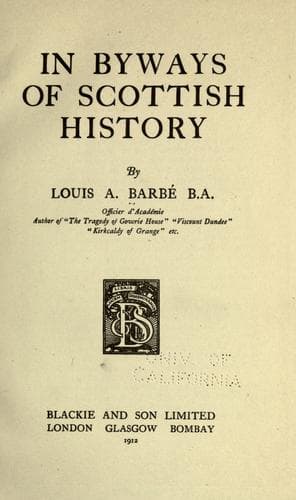
Scotland -- History -- Stuarts, to the Union, 1371-1707
"Si je suis en repos,
Sommeillant sur ma couche,
J'oy qu'il me tient propos,
Je le sens qui me touche;
En labeur ou requoy
Toujours est près de moi.
XV
"Je ne voy autre object
Pour beau qu'il se présente;
A qui que soit subject
Oncques mon coeur consente,
Exempt de perfection
A ceste affection.
XVI
"Mets, chanson, icy frain
A si triste complainte,
Dont sera le refrain:
'Amour vraye et non faincte
Pour séparation
N'a diminution'."
XVII
Tel estoit le doux chant
De Dame souveraine,
Qui, mon coeur arrachant
D'une fuite soudaine,
Me donna en ce lieu
Coup mortel d'un Adieu.
We recall that the stanzas which we have numbered I and II constitute
the Song which, according to Brantôme, was composed "at Court"; and that
those from VI to XVI, inclusively, are, with an alteration of the first
line, and some slight variations elsewhere, what he called the Song of
Mary Stuart herself. The title, the three connecting stanzas III-V, and
also the last, XVII, were discovered in the Périgueux manuscript
FOOTNOTES: for THE SONG OF MARY STUART
[106] T. v, pp. 84, 85, 88-90, 123.
[107] Périgueux, Cassard frères.
[108] _Ibid._
MAISTER RANDOLPHE'S FANTASIE
A Suppressed Satire
About the middle of May, 1566, Robert Melvill was dispatched by Mary,
Queen of Scots, as a special envoy to the English Court. The ostensible
purpose of his mission was to request Queen Elizabeth to stand godmother
to the royal infant whose birth was shortly expected.[109] And it was,
indeed, with this object that his journey had, in the first instance,
been resolved upon. But, three or four days before the time originally
fixed for his departure,[110] he had been hastily summoned to Holyrood
and ordered to set out at once, and with all speed, on an errand of a
very different kind. According to the tenor of his later instructions,
he was the bearer not of a friendly message from Mary Stuart to her
loving cousin, but of a bitter complaint from the Queen of Scotland to
the English sovereign. Mary had been informed by one of her agents at
Berwick that "there was a booke wrytten agaynst her, of her lyf and
govermente".[111] Though possessing no actual knowledge of the contents
of the obnoxious libel and acquainted with its general tone and purport
only, she had "taken it so grevouslye as noth[=y]ge of longe time had
come so near her hearte".[112] Not only did she resent the insult as a
sovereign, but she also felt the outrage as a woman, and expressed her
fear lest, having come to her so suddenly and at so critical a time, the
unwelcome intelligence "sholde breed daynger to her byrthe or hurte to
her selfe".[113] And Melvill had been hurried off to London to inform
Elizabeth of the crime committed by one of her subjects, "that in tyme
this worke mighte be suppressed and",[114] more important still,
Public-domain text, read in full here on John Shaqi.
Reviews
Reviews
No reviews yet
Be the first to share your thoughts on this work.
Join the Discussion
Join the discussion
Sign in to leave a comment or review.
Sign InorCreate an account