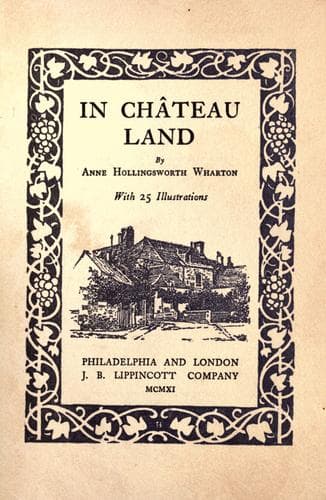
Castles -- France; Touraine (France) -- Description and travel
You will think that my pen has run away with me in following the
fortunes of Louise de La Valliere from Blois to Paris and from Paris to
Versailles; but Lydia and I have been reading a book about Blois which
M. La Tour had sent to us from Paris. This book, which dwells
particularly upon the story of Louise de La Valliere and her association
with the Chateau of Blois, has brought the life of that time before us
so vividly that we feel as if we had some part and lot in the pathetic
tale. The festivities and intrigues of Fontainebleau and Versailles may
seem a far cry from the old Chateau of Blois, and yet the court life of
that older time, dramatic and picturesque as it was, was curiously
limited. The characters were always the same, the pageant alone shifted
from palace to chateau, and from one chateau of the Loire to another.
Now the court is at Amboise, again at Chenonceaux, and again at the
stately palace of Chambord. The King is always surrounded by the same
courtiers and the same favorites, whether he is riding through the
forest of Fontainebleau or hunting at Chambord, in which princely domain
Louis boasted that he had shot fourteen of his Uncle Gaston's cherished
pheasants in one afternoon. The distances are short, and even in the
days of slow-going coaches the court could breakfast at Chambord and sup
at Blois.
Through the influence of a distant relative Louise de La Valliere was
given a place at court in the service of the English princess, the
beautiful, captivating and capricious Henriette, daughter of Charles I
and wife of the King's young brother, Philippe d'Orleans. Chroniclers of
the time all agree in attributing to her rare charm of manner, a lively
wit and a keen intellect. A patron of the great writers of the day, she
encouraged Corneille and the older poets and emboldened the younger by
her appreciation. Henriette wept over the _Andromaque_ when Racine read
it to her, until the happy youth's head was well-nigh turned by what he
considered the most fortunate beginning of its destiny. This combination
of beauty, charm, and intellect, found more frequently, perhaps, in
France than in any other country, rendered Madame the most irresistible
of women, and as Saint-Beuve says, the most touching of princesses. The
King, who at sixteen had refused to dance with the thin and not
especially attractive child of eleven, because, as he explained to his
mamma, he did not care for little girls, took himself to task later for
not realizing before she became his brother's fiancee that Henriette was
the most beautiful woman in the world.
Public-domain text, read in full here on John Shaqi.
Reviews
Reviews
No reviews yet
Be the first to share your thoughts on this work.
Elsewhere in the archive
Join the Discussion
Join the discussion
Sign in to leave a comment or review.
Sign InorCreate an account